It Was Just an Accident and the Weight of Not Knowing
Jafar Panahi's Palme d'Or winner is a revenge thriller built on a doubt that can never be cleared, and the doubt is the point.
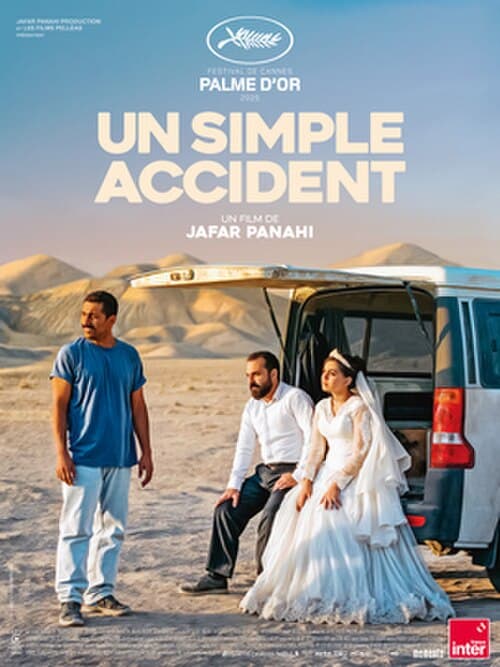
Poster via Wikipedia, It Was Just an Accident. Used under fair use for criticism and review.
The first thing It Was Just an Accident does is withhold a face. A car moves along a dark road outside Tehran, a small mechanical fault, a dog struck, a family briefly frightened; and then a sound, the squeak of a prosthetic leg crossing a workshop floor. A mechanic named Vahid hears it and cannot stop hearing it. He does not see the man clearly. He recognises him by his gait, by the noise his body makes in a quiet room, and that recognition is the trap the film then chooses to live inside. Jafar Panahi has made a thriller whose engine is a doubt that can never be cleared, and he has refused, for two hours, to clear it.
The film took the Palme d’Or at Cannes in May 2025, handed to Panahi by a jury under Juliette Binoche, the sixth consecutive year the prize has gone to a film Neon is releasing in North America. It runs a compact 104 minutes. It is an Iran, France and Luxembourg co-production, shot by Amin Jafari and cut by Amir Etminan, and it was made the way Panahi now makes everything, without a permit, against a filmmaking ban that has been in force in one form or another since 2010. He was arrested again in 2022, held in Evin prison, and released in February 2023 after a hunger strike. This is the first feature he has made since walking out of that building.
The man in the boot
Vahid, played by Vahid Mobasseri with a clenched, watchful stillness, does not deliberate for long. He knocks the man out, puts him in the boot of a van, and drives into the desert to dig a grave. Then the doubt arrives, on schedule, and the film becomes something stranger than the abduction it opened with. He cannot be sure. The prisoners who were tortured by a man they called Eghbal were blindfolded the entire time; they knew him by a voice, a smell, the drag of an artificial leg, never a face. So Vahid does the only thing available to a man who needs certainty and has none. He goes looking for witnesses.
What follows is a road movie assembled out of former political prisoners, each summoned to look at a bound stranger and say whether the body in the van is the body that broke them. Shiva, a wedding photographer played by Mariam Afshari, is mid-shoot when Vahid pulls her away, the bride still in the car. Hamid is angrier and surer than the evidence allows. Goli has her own account to settle. None of them saw the man either. They are being asked to identify a face none of them ever had.
What the camera refuses
Jafari shoots most of this in cars, in the flat punishing daylight of the city’s edge, and the camera is disciplined about what it will not give us. Panahi keeps the captive (Ebrahim Azizi) largely silent and largely hooded for the first stretch, so that we are placed exactly where his accusers are placed: in the presence of a man who might be a monster or might be a plumber on his way home, with no instrument for telling the difference except conviction. The film withholds the reverse shot that a lesser thriller would race toward. It will not confirm the kill is justified, because confirmation is the one thing torture under a blindfold makes impossible. The prisoners were blindfolded; the film hands the blindfold to us, and then asks what we are prepared to do while wearing it.
That is the formal achievement, and it is inseparable from the moral one. Every escalation, every argument over a shovel, every reasonable-sounding case for proceeding, is built on a foundation the film has already told us is unstable. We want them to be right. We want the squeak to belong to Eghbal. Panahi makes that wanting visible, and slightly shameful, which is a harder thing to do than to stage a confrontation.
The argument in the van
The middle of the film is mostly talk, and the talk is where the picture earns its prize. These people do not agree. One wants the man dead and is honest that he wants it for himself, not for justice. One cannot stop being a decent person even now, and keeps offering the captive water. When the man’s pregnant wife goes into labour, the group ends up at a hospital, abetting the comfort of the very household they may be about to destroy, and the absurdity is not played for relief. It is the point. Revenge keeps colliding with the ordinary machinery of other people’s lives, and the machinery wins more often than the revenge does.
Panahi has always been a director of confined spaces standing in for a confined country. This Is Not a Film was shot inside his own flat under house arrest; Taxi turned a car into a cinema and a courtroom; No Bears watched him watch a village from the border. It Was Just an Accident extends that method into the genre of the manhunt, and the confinement this time is epistemic as much as physical. The country has put these people in a position where the only available form of knowledge is testimony, and testimony, the film keeps insisting, was deliberately corrupted at the source by the blindfold.
The squeak at the door
The ending I will not spell out, except to say that the captive is eventually allowed to speak, and what he says is neither the full confession the genre demands nor the clean exoneration that would let everyone go home. He explains himself in the language of a man who was following orders, which is to say he apologises and justifies in the same breath, and the apology is somehow worse than silence. Then the film closes on a sound rather than an image: the squeak again, approaching, in a place it should not be.
It is a closing gesture that hands the doubt back to the audience one last time, unresolved on purpose. Panahi could have told us whether they had the right man. He has decided that the certainty we crave is exactly the thing a regime built on blindfolds has made unavailable, to his characters and to us, and that pretending otherwise would be the real lie. The film does not forgive the torturer. It does something more unsettling. It declines to let us be sure there was one in the van at all, and it asks what our certainty was for. That refusal is the work of a director who has spent fifteen years learning that the most political thing a camera can do is decline to look away, and the second most political is decline to confirm. He has built a whole film out of the second.
Lena writes long-form essays on the films that will still be talked about in a decade. Previously at a defunct monthly whose name we do not speak.
MORE BY LENA ASHWORTH →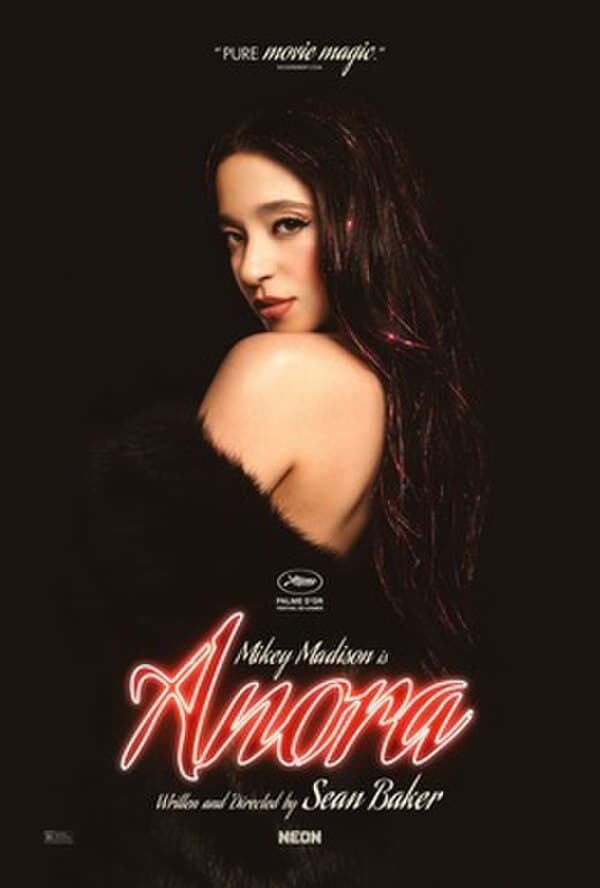
What Anora's Ending Pays For
Sean Baker's Brooklyn fairytale won five Academy Awards on the strength of two minutes of silence in a parked car. The film is more interested in what that silence costs.
The Seed of the Sacred Fig: Rasoulof's House Film
Mohammad Rasoulof shot the film in secret, fled Iran during post-production, and arrived at Cannes with a three-hour domestic thriller about a judiciary father and his protesting daughters. The retrospective argument is that the long cut is the cut.
The Running Man Spent Like a Star Vehicle Without a Star
Edgar Wright's Stephen King adaptation took $69 million worldwide on a $110 million budget. The film was fine. The price tag assumed a star Paramount had never actually tested.