The Last Five Minutes of 28 Years Later Belong to a Different Film
Danny Boyle made a film about a boy walking his mother across a dead country, then handed the last reel to a sequel he was not directing. The seam is visible and it is worth arguing about.
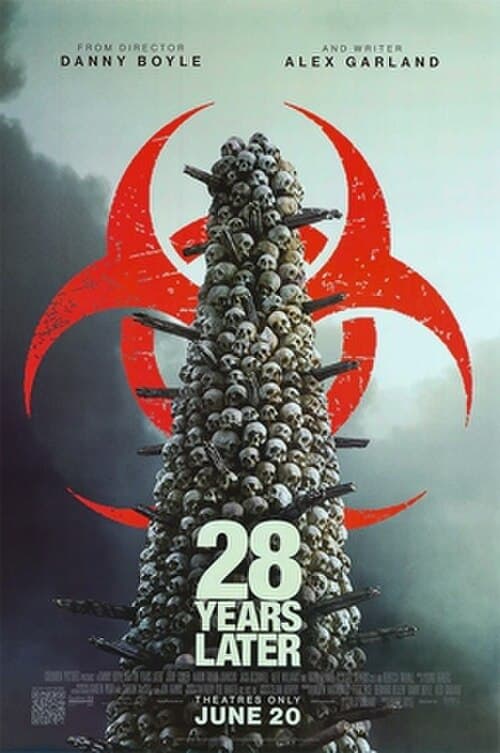
Poster via Wikipedia, 28 Years Later. Used under fair use for criticism and review.
Let me get one thing out of the way. 28 Years Later is a good film, and the part everybody has been arguing about since June 2025 is not a failure of nerve. It is a delivery. Danny Boyle did not lose control of his ending. He was never holding it.
The numbers first, because they explain the shape. The film opened on 20 June 2025, runs 115 minutes, cost a reported $60 million and took $151.3 million worldwide. Those are healthy numbers for a horror sequel arriving twenty-three years after the original, and they were healthy enough that the follow-up, 28 Years Later: The Bone Temple, was already in the can. It was shot back-to-back, directed by Nia DaCosta rather than Boyle, and released in January 2026. A third film has Boyle attached. Sony did not buy a film. Sony bought a trilogy, and a trilogy has to be paid for out of somebody’s ending.
What the camera is actually doing
Anthony Dod Mantle shot it, largely on iPhone 15 Pro Max bodies mounted in custom rigs, in a 2.76:1 frame. Every write-up in the world reported the phone and then moved on, which is the wrong emphasis. Dod Mantle also shot 28 Days Later in 2002, on Canon XL1 MiniDV cameras, sometimes eight of them at once, because that was the only way to cover an empty London in the minutes available before traffic returned. The consumer camera is not a gimmick imported for the sequel. It is the only continuous formal idea the franchise has ever had.
What the phones buy here is different from what the XL1s bought. The XL1 gave 2002 a smeared, contrast-crushed image that read as broadcast news, which was the point: an outbreak that looked like footage. The iPhone array gives 2025 something stranger, an anamorphic-width frame at a resolution the eye reads as too clean, hung off rigs light enough to be carried into terrain no crane would reach. The infected attacks are covered from a dozen positions at once and cut into bursts, so a chase reads less like coverage than like a lenticular card being tilted.
Jon Harris cut it, and Young Fathers scored it, and the two of them are doing most of the work that horror normally asks a monster to do. There is a sequence on the causeway to the island community, tidal, timed, negotiable only twice a day, where the score simply refuses to escalate. The rhythm section stays flat. Nothing swells. The film is telling you, quite early, that it does not intend to work the way the trailer said it would.
The film it turned out to be
Because it is not, in the main, a chase picture. It is a boy’s film. Alfie Williams plays Spike, twelve, raised on a fortified tidal island by a father who has made peace with the arrangement and a mother who has not. Aaron Taylor-Johnson plays Jamie as a man whose competence is a kind of cowardice; he is good at the survival and useless at everything the survival was supposed to protect. Jodie Comer plays Isla, ill with something the island cannot name or treat, and the actual plot of 28 Years Later is a child deciding to walk his sick mother across a quarantined country to find a doctor who may not exist.
Ralph Fiennes plays the doctor. Kelson is the best thing in the film and the least sellable: a man who has spent decades building an ossuary out of the dead, iodine-stained, entirely lucid, keeping a ledger nobody will ever audit. Fiennes plays him without a single beat of eccentricity-for-effect. He is calm because the alternative was to stop, and he did not stop.
That film, the boy and the mother and the bone temple, is a coming-of-age drama with an infected-rage skin stretched over it. It has a real ending. Spike gets his mother to the only mercy available, understands what he has done, and walks back out into the country alone rather than home. Fade there and you have a complete, hard, unusually generous piece of studio filmmaking about a child taking on an adult’s knowledge.
The marketing was selling a metronome
The campaign is worth attacking separately, because it was extremely good and it was advertising a different product. The teaser ran Taylor Holmes’ 1915 recital of Kipling’s “Boots” underneath the cutting, a recording so relentless that the US military has used it in resistance training. Boots, boots, boots, boots. It is a genuinely upsetting piece of audio and it promised an army: massed infected, a country overrun, scale.
The film has an Alpha, a handful of set pieces, and a long middle stretch of two people walking. I say this with no pleasure, because the trailer is the best trailer of 2025 and it is the reason a lot of people bought a ticket for a film about maternal palliative care. The gap between the two is not the marketing department lying. It is the marketing department correctly identifying that the studio had bought a franchise, and cutting a franchise trailer for the instalment that happens not to be one.
The handoff
Then the last five minutes. Spike, alone on the road, is set upon and rescued by a gang of bleached, tracksuited survivors led by Jack O’Connell’s Jimmy Crystal, staged in a register of cartoon violence that the preceding 110 minutes has given you nothing to prepare for. The tonal shear is total. People walked out of that sequence in June 2025 genuinely angry, and the standard defence was that Boyle earned it, or that the film had always been playing with tone.
Neither is true and neither is necessary. That sequence is a trailer, cut into the end of a film, for a picture Boyle was not directing and DaCosta had already shot. It exists to install a villain who pays off elsewhere. Judged as an ending it is a failure. Judged as what it is, a handoff, it is efficient, and the only real complaint is that a studio made a self-contained film pay the freight for the one behind it.
There is an honest version of this that nobody in the chain would have approved, and it is not longer or cleverer. It is shorter. Cut the Crystal material entirely, put it at the head of The Bone Temple where it belongs, and 28 Years Later becomes what its middle hour keeps insisting it is: Boyle’s most patient film since Sunshine, an argument that the horror in an outbreak story is never the infected, it is the arithmetic that a twelve-year-old has to do about his own mother.
He does the arithmetic. He gets it right. And then a man in a shell suit turns up to advertise January.
Marcus believes good criticism is an argument. He is almost always angry about something, usually for good reason. Horror is his first language.
MORE BY MARCUS VELL →
Warfare: Mendoza and Garland's Real-Time Iraq
Ray Mendoza and Alex Garland's second collaboration rebuilds a 2006 Ramadi engagement from the memories of the men who survived it, and the film's claim on attention is its specific refusal to shape.
The Running Man Spent Like a Star Vehicle Without a Star
Edgar Wright's Stephen King adaptation took $69 million worldwide on a $110 million budget. The film was fine. The price tag assumed a star Paramount had never actually tested.
The Secret Agent and the Leg in the Shark
Kleber Mendonça Filho's Recife thriller left the Academy Awards with nothing from four nominations. Its subject was never the chase. It was who gets to keep the record of a city.