One Battle After Another and the Comedy of Forgetting
Paul Thomas Anderson's Pynchon adaptation took six Academy Awards and $213.1 million, and the reason it works is a running joke about a man who cannot remember a phrase.
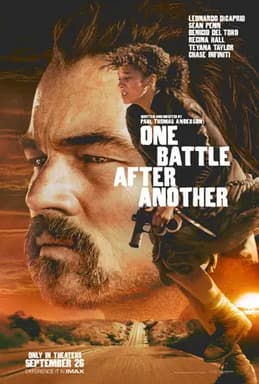
Poster via Wikipedia, One Battle After Another. Used under fair use for criticism and review.
The most consequential piece of information in One Battle After Another is a sentence, and the protagonist cannot produce it. He has had sixteen years to keep hold of it. It is the only thing standing between his daughter and a man with a service record. He is on a landline, sweating, and the phrase will not come.
That is the film. Everything else is chase.
Paul Thomas Anderson premiered the picture on 8 September 2025 and Warner Bros. put it into wide release on 26 September, 162 minutes long, against a reported budget somewhere between $130 million and $175 million. It took $213.1 million worldwide, which is not the number a studio dreams about on that outlay, and then it took six Academy Awards from thirteen nominations at the 98th ceremony: Picture, Director, Adapted Screenplay, Supporting Actor for Sean Penn, Film Editing for Andy Jurgensen, and Casting. The awards conversation settled on the film as a political statement. The first-week reception did too. Both were reading the plot.
What Anderson took from Pynchon and what he left
The source is Vineland, the Thomas Pynchon novel from 1990, and the adaptation problem with Pynchon has always been the same one: his books are about the residue of political commitment, the way a movement becomes a hangover, and residue is not dramatic. It sits there. A novel can spend three hundred pages on the texture of what is left over. A film has to move.
Anderson’s solution is to convert political memory into procedural memory. The revolutionary infrastructure of the French 75 does not survive in the film as ideology; it survives as protocol. Phone trees. Code phrases. A number you ring, a person who answers, a thing you are supposed to say. Bob Ferguson, played by Leonardo DiCaprio, is what remains of a radical after the radicalism has drained out and left only the operating instructions, and he has lost the operating instructions too.
This is why the password scene lands the way it does. It is a farce built out of a genuine terror, and the terror is not that the system will fail. The system works perfectly. The people on the other end of the line are competent, patient, still committed. Bob is the broken component.
Bauman, VistaVision, and why the frame is that wide
Michael Bauman shot between seventy-five and eighty per cent of the film in VistaVision on 35mm, which is a horizontal eight-perforation format that runs the film sideways through the camera and produces a negative roughly twice the area of standard 35mm. Studios abandoned it around 1961 because it was expensive and the projection advantage never materialised. Its recent life has been almost entirely in visual-effects plate photography.
The reason to use it here is not resolution. It is that VistaVision holds detail across a very wide frame without the compression you get from anamorphic, and Anderson wants the width because he keeps putting two incompatible things in the same shot. A domestic interior and a tactical formation. A teenager and an armoured vehicle. The film’s political argument is almost never spoken; it is staged, as adjacency, and the format is what lets the adjacency be sharp at both ends of the frame.
Penn’s Colonel Steven J. Lockjaw is the best demonstration. Penn plays him with the spine locked and the head slightly forward, a man who has organised his body into a piece of equipment, and Bauman shoots him at distances that let you see the whole apparatus at once: posture, uniform, the space other people leave around him. Compare that to how DiCaprio is framed, usually too close, usually in a bathrobe, usually with something in his hand he has forgotten he is holding. The two men are photographed as different categories of object.
Jurgensen’s cut is the political argument
The editing Oscar was the correct one and it was also the least discussed. Andy Jurgensen is doing something structurally unusual with the sixteen-year gap at the centre of the picture: he does not signal it, dramatise it, or bridge it. The film simply resumes on the other side of a life, and the audience is left to reconstruct what happened from wear and tear.
That refusal is the whole thesis. A conventional version of this story would give us the decline. We would see the cell fracture, the paranoia set in, the drinking start. Anderson and Jurgensen delete the decline and give you only the before and the after, which means the audience performs the work of remembering that Bob himself cannot perform. You are asked to hold the two halves of a man in your head simultaneously. He cannot.
Jonny Greenwood’s score does the reciprocal job. He writes for the earlier section with propulsion, an ensemble that sounds like it is going somewhere, and for the later section with a kind of stalled repetition that keeps promising to resolve and does not. There is no grieving cue. Greenwood scores the forgetting rather than the loss, which is a harder and colder choice.
Teyana Taylor, Chase Infiniti, and the actual handover
The film’s emotional line is not father and daughter. It is Perfidia Beverly Hills and Willa, mother and daughter, two performances by Teyana Taylor and Chase Infiniti that never share a scene in the present tense and are constructed to rhyme anyway. Taylor plays conviction as appetite, a woman for whom the politics and the danger and the sex are one undivided thing, and Infiniti plays the inheritance of that without the ideology attached, which is a much stranger assignment and she does not flinch at it.
Bob is between them, and he is comic relief in his own family’s story. DiCaprio has never been funnier and he has rarely been used this unkindly. Benicio del Toro’s Sergio St. Carlos, calm and unhurried and the only adult in most rooms he enters, exists partly to measure how far Bob has fallen: here is what competence looks like, standing right next to you.
Where it sits now
The awards framing did the film no favours. Read as a statement about the American present, One Battle After Another is blunt, and its detractors were right that the politics are stated rather than examined. Read as what it is, a film about the difference between believing something and remembering that you believed it, it is the sharpest thing Anderson has made since There Will Be Blood, and the sharpness is technical: a wide format that refuses to separate the domestic from the militarised, an edit that withholds the decline, and a score that will not mourn.
The chase on the desert highway near the end has been described everywhere as a set piece, and it is one. It is also the film’s argument in miniature. Three cars go over a rise and disappear, and for a second nobody on screen or in the audience knows what is on the other side. Bob does not know. He never knew. He has been driving into the blind crest for sixteen years and calling it a life.
Lena writes long-form essays on the films that will still be talked about in a decade. Previously at a defunct monthly whose name we do not speak.
MORE BY LENA ASHWORTH →
The Brutalist: In Defence of the 3.5-Hour Epic
A year after The Brutalist swept its technical categories and divided audiences, its length has stopped looking like a gamble and started looking like the point. An argument for the long film in a short-film decade.
Superman Had to Launch a Universe and Be a Film at Once
James Gunn's Superman was carrying a whole rebuilt DC on its back and still had to be a movie for two hours. It managed both, and the strain shows in exactly one place.
Materialists Is a Film About Pricing, Not Dating
Celine Song's second feature was sold as a romantic triangle. It is really an argument about what happens to people once you agree to put a number on them.