Caught by the Tides and the Archive of a Face
Jia Zhangke built his new film out of twenty-two years of his own discarded footage. The result is the rare picture whose real subject is the time it took to shoot.
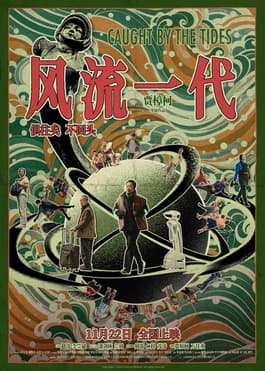
Poster via Wikipedia, Caught by the Tides. Used under fair use for criticism and review.
There is a face at the centre of Caught by the Tides, and the remarkable thing about it is that we watch it age in real time across twenty-two years. The face belongs to Zhao Tao, who has been the lead in almost every film Jia Zhangke has made, and who plays here a woman called Qiaoqiao with almost no dialogue at all. Jia assembled the film, in part, out of footage he had been shooting of her since 2001, material left over from earlier pictures, screen tests, documentary fragments, things that never had a home. The first time you understand what you are looking at, that the young woman in the Datong dance hall and the older woman in the COVID-era supermarket are the same actress photographed two decades apart, the film stops being a story and becomes something stranger and more moving: an archive of a person, and of a country, and of the working relationship between a director and his wife.
This is not a gimmick, though it could have been. The decision came partly out of necessity. The pandemic made shooting in China difficult, and Jia, sitting on a vault of unused footage going back to Unknown Pleasures (2002), Still Life (2006), and Ash Is Purest White (2018), began to wonder whether the discards added up to a film on their own. They did. The picture premiered in competition at Cannes in 2024, runs a shade under two hours, and is credited to two cinematographers, Yu Lik-wai, Jia’s longtime collaborator, and Éric Gautier, which tells you something about how many different eras of film stock and format are stitched into it.
The thesis the form forces
I want to make a single argument about this film, because it is a film that rewards one. Most movies treat their own production time as a problem to be hidden. Continuity exists to pretend that two shots filmed months apart happened in the same afternoon. Makeup and lighting exist, among other things, to keep an actor looking the same across a shoot. Caught by the Tides throws all of that away and makes the passage of real time its subject. The wrinkle that was not there in 2001 and is there in 2022 is not a flaw the film is managing. It is the film.
Qiaoqiao moves through the picture chasing, and then no longer chasing, a man called Bin, who leaves Datong to find money in the south and sends word that he will come back for her when he has it. She follows the rumour of him across the country and across the years, through the towns being cleared for the Three Gorges Dam, through the reservoir that drowned them, into a present of delivery apps and face masks. The plot, such as it is, is a thread to hang two decades on. The real movement is China itself, photographed not as a backdrop but as the thing actually changing while the human story marks time.
Why the silence works
Zhao Tao’s near-wordlessness is the boldest choice in the film and the one most likely to lose an impatient viewer. She is not mute; she simply almost never speaks, and the film asks her face to carry what dialogue normally would. This is where the archive idea pays off completely. Because we are watching a real actress age across real years, every expression arrives with the weight of having been earned over a career. When Qiaoqiao looks at a man she has spent twenty years not getting over, Zhao is also, unavoidably, an actress looking back across twenty years of being photographed by the same director. The performance and the production become the same act.
Jia has always been the great chronicler of what China’s transformation cost the people standing in its way, the demolished towns of Still Life, the small-time gangsters of his early work left behind by the boom. Here he does it by letting the boom happen inside a single film, in the visible texture of the image: the grainy digital video of the early footage giving way to the cleaner, colder look of the recent material. You can date the China you are looking at by the quality of the photography. That is a kind of historical writing almost no other director has the back catalogue to attempt.
What it leaves you with
The risk of a film built this way is that it becomes an exercise, fascinating to describe and inert to watch. Caught by the Tides mostly avoids this, and where it does not, the lapses are forgivable, because the central conceit keeps reasserting its emotional logic. By the closing stretch, when Qiaoqiao moves through a present that the young woman of 2001 could not have imagined, the film has quietly become an essay on endurance, on the cost of waiting, on what it means to keep going through a country that keeps deciding to become something else.
Jia did not set out, decades ago, to make this picture. He set out to make several other ones, and kept the pieces that did not fit. That he could later look at twenty-two years of leftovers and find a whole film inside them is not luck. It is what it looks like when a director and an actress have spent their working lives building, without quite knowing it, a single continuous record of a face.
Lena writes long-form essays on the films that will still be talked about in a decade. Previously at a defunct monthly whose name we do not speak.
MORE BY LENA ASHWORTH →
The Thing Was Not Rejected in 1982. It Was Mis-Sold.
John Carpenter's The Thing earned back its budget and was savaged anyway. The record says the film was not the problem. The poster, the tagline and the weekend it opened were.
Drive My Car and the Business of Letting Someone Else Take the Wheel
Ryusuke Hamaguchi's three-hour adaptation is usually described as a film about grief. It is closer to a film about who is permitted to drive, and what a man gives up when he finally hands over the keys.
The Warriors Was a Hit That Its Own Studio Treated as a Threat
A $4 million picture grossed about $22.5 million, and Paramount still spent the spring of 1979 pulling its own advertising. The Warriors is a case study in a studio mistaking its audience for the film.