Captain America: Brave New World and the Cost of a Reshot Blockbuster
Marvel's fourth Captain America opened in February 2025 to middling reviews and soft legs. The visible seams on screen tell the bigger story about what the studio spent the second half of 2024 doing to the film.
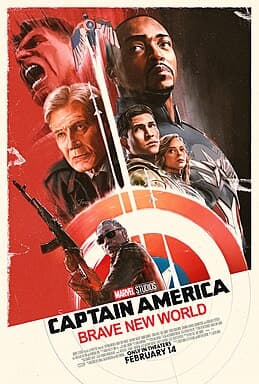
Poster / promotional material via Wikipedia, Captain America: Brave New World. Used under fair use for criticism and review.
Captain America: Brave New World opened on 14 February 2025 with a $88.5 million domestic three-day, closed its first week at a tick under $140 million worldwide, and then fell almost 70 per cent in its second weekend. The reviews were not kind. The audience Cinemascore was a B-, which, for a Marvel property, is the bottom quartile of the last decade. The film is not a disaster on the scale of The Marvels. It is something quieter and possibly worse: a studio release visibly rebuilt in the editing suite and marketed as if nothing had happened.
The picture Anthony Mackie, Julius Onah, and the cast delivered is not the picture on screen. The picture on screen is the result of reshoots reported across late summer and autumn 2024, including a late-stage rewrite credited to Matthew Orton, additional photography to strengthen the Harrison Ford thread, and a recut that flattened at least one full subplot involving Shira Haas. The Sabra character was trimmed and repositioned after sustained online pressure about the politics. The net effect is a film in which you can see the joins.
What got reshot, as far as anyone can tell
Studios do not publish reshoot manifests, and trade reporting during late 2024 was fragmentary. What is visible on screen and triangulated by the trade coverage: the third act was substantially redesigned, the Red Hulk sequence was expanded, a secondary antagonist (an Esposito-adjacent handler) was reduced, and the Haas character’s function was pulled back from what early press materials had suggested. A third reshoot pass in November 2024 appears to have added the final action beat at the Lincoln Memorial, which lands on screen as a tonally separate sequence from everything before it.
The specific narrative cost is visible in Mackie’s performance. The first hour gives him a clearly plotted arc (the new Cap is working a diplomatic-guard function, is reporting to Ford’s President Ross, is navigating the specific question of whether the shield requires moral authority he has not yet earned). The second hour, the reshot hour, does not give him anything to play against. The arc flattens into action carriage. Mackie is a better actor than the film is letting him be.
The Ford casting problem
Harrison Ford, cast as Thaddeus Ross after William Hurt’s death, is the specific case that illustrates what the reshoots cost. Ford is a star whose presence alone can carry a scene, but the film has to build around the fact that Hurt’s Ross, across the earlier Marvel films, was a different kind of character. Ford plays Ross younger in affect than Hurt did, more politically glib, more visibly amused by the power. The reshoots appear to have leaned into this register (more scenes of Ross working a room, fewer scenes of Ross alone with his daughter or his aides) and the net effect is that the political thriller premise cannot fully support the weight the film places on it.
The Red Hulk sequence, the third-act capstone, is where Ford’s contract and the studio’s visual-effects budget meet and the film decides to resolve every structural problem by hitting it with a CGI giant. The sequence is serviceable. It is not a climax the preceding two hours have earned.
The Giancarlo Esposito question
Giancarlo Esposito was announced late (January 2024) and appears in a reduced capacity that trade reporting attributes to the reshoots. His character, a handler called Sidewinder, functions as a connective tissue role between Cap’s investigation and the larger antagonist infrastructure. The role does not give Esposito anything specific to do. This is a consistent Marvel failure mode (adding a major actor late, then trimming the role in post) and it hurts this film in a specific way because Esposito is the only antagonist presence in the first act with the charisma to carry the political-thriller tone the opening sets up.
The politics they could not fix
The Sabra controversy dominated pre-release coverage from 2022 onward. The character, as she exists in Marvel Comics, is an Israeli Mossad operative, and the announcement in September 2022 that she would appear in Brave New World was met with sustained criticism that intensified across 2023 and 2024. Marvel’s response, communicated through the trade press across 2024, was that the character would be substantially reworked. The film as released gives Haas a reduced and depoliticised role that reads, on screen, as the result of exactly the kind of back-room rewrite the coverage had suggested. Neither the original character’s supporters nor her critics appear to have been satisfied.
This is the specific failure of the Marvel political-thriller register. The Winter Soldier comparison, which the marketing invited, worked in 2014 because the film’s politics, such as they were, were legible as genre politics (a surveillance-state paranoia drawn from 1970s thrillers). Brave New World, fifteen years into the MCU and three years into the Sabra discourse, could not adopt the same posture without engaging a political question the studio was unwilling to engage.
What the Onah cut might have looked like
Julius Onah is a filmmaker I like (Luce in 2019 is a specifically controlled two-hander about race, authority, and narrative framing) and I am reluctant to judge him on this material. The early first act of Brave New World, before the reshoots become visible, has a specific compressed-procedural feel that suggests the film Onah might have been trying to make. It is a film about the weight of the shield, the specific politics of a Black Captain America in a second Ross administration, and the moral cost of working inside a power structure that you have good reason to distrust. That film exists on screen in fragments.
The film that got released is not that film. It is a rescue, and the rescue is visible. Onah will get a better project at a better studio. Mackie will, eventually, get the Cap film he has earned. This is not it.
What the commercial numbers mean
The opening three-day sat below the sequel-holdover Marvel benchmark and above The Marvels. The second-weekend drop (around 68 per cent) is the number that hurts. For reference, Doctor Strange in the Multiverse of Madness dropped 67 per cent in 2022 and was considered a disappointment; Ant-Man and the Wasp: Quantumania dropped 69 per cent in 2023 and triggered the current round of Marvel strategic rethinking. Brave New World is in that band.
The specific commercial damage is to Mackie’s solo franchise. A second film in this incarnation is likely but will need to rebuild from a weaker base than the previous Cap trilogy did. The Thunderbolts* release in May 2025 is now carrying more weight than the studio would have planned for.
What survives
Mackie’s performance in the first act. A small number of reshot-free character scenes (specifically a two-hander between Mackie and Carl Lumbly’s Isaiah Bradley that continues the thread from the Falcon and the Winter Soldier series). The production design of the first half, which uses the DC locations with specific attention. Ford’s raised eyebrow, which is still worth something.
The film as a whole is not worth the time. It is a case study in what happens when a studio reshoots a blockbuster into structural incoherence and then prays that the opening weekend carries the damage. The opening weekend did. The second did not. Marvel’s recovery plan, such as it is, will have to work around this film rather than through it.
Marcus believes good criticism is an argument. He is almost always angry about something, usually for good reason. Horror is his first language.
MORE BY MARCUS VELL →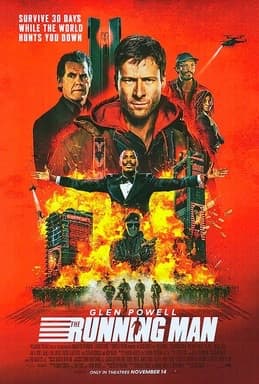
The Running Man Spent Like a Star Vehicle Without a Star
Edgar Wright's Stephen King adaptation took $69 million worldwide on a $110 million budget. The film was fine. The price tag assumed a star Paramount had never actually tested.
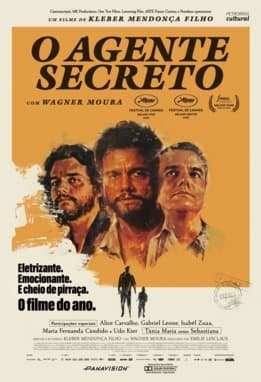
The Secret Agent and the Leg in the Shark
Kleber Mendonça Filho's Recife thriller left the Academy Awards with nothing from four nominations. Its subject was never the chase. It was who gets to keep the record of a city.
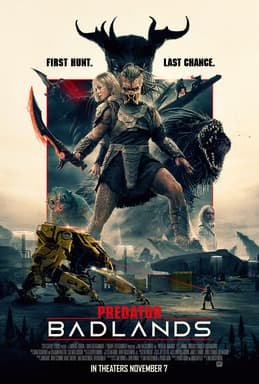
Predator: Badlands Bet the Franchise on a PG-13
Everybody wrote about the Predator becoming the protagonist. The genuinely dangerous decision was the rating, and it returned $184.6 million on a $105 million budget.