Tigers Blood and the Second Waxahatchee Record
Katie Crutchfield's follow-up to Saint Cloud did not need to do anything except be good. It is good in specific, deliberate ways, and those ways are the record's argument for itself.
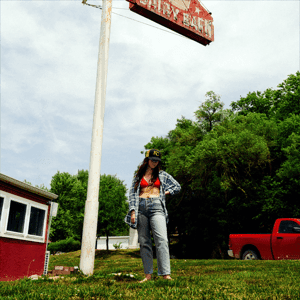
Poster / promotional material via Wikipedia, Tigers Blood. Used under fair use for criticism and review.
The first time I put Tigers Blood on was March 2024, in a Brooklyn apartment that was not mine, on a kitchen stereo that was not great. The second time I put it on, properly, was that same week, driving north out of the city on I-87 with the windows down. I have now listened to the record enough times that I cannot count them honestly, which is the specific kind of relationship I have with two other Waxahatchee records and with almost nothing else.
A year and change out, Tigers Blood is the record I think Katie Crutchfield will be known for in twenty years. Not because it is her most innovative. Saint Cloud (2020) was the record where she pivoted, from the noisier indie-rock of the early Waxahatchee material, into the specifically American country-folk register she has since made her own. Tigers Blood is not that pivot. It is the record where the pivot becomes a sustained practice, and the practice makes the pivot look, in retrospect, inevitable.
What the record is
Tigers Blood was released on 22 March 2024 through Anti- Records. It was produced by Brad Cook, who produced Saint Cloud, at Sonic Ranch in Tornillo, Texas. The band includes MJ Lenderman on guitar and backing vocals across most of the record, Phil Cook on keys and bass, Spencer Tweedy on drums, and Crutchfield on guitar and lead vocal. It runs around 52 minutes across 12 tracks.
The Lenderman contribution is the surface-level feature the critical coverage focused on. Lenderman, whose own Manning Fireworks was released in September 2024, has become one of the more interesting guitar players in American indie music, and his playing on Tigers Blood is the kind of contribution that does not announce itself but cannot be subtracted. His vocal turn on “Right Back to It,” which was the record’s first single, made the song a cross-audience hit in a way Waxahatchee singles have not previously been.
But the record is not, in any central sense, a duo record. It is a Crutchfield record with a guest guitar player whose voice happens to work in harmony with hers. The argument of the record is Crutchfield’s.
The argument
I want to describe what I think the record is doing, because it is a specific thing, and the specific thing is not what the reviews mostly captured.
Saint Cloud was a record about sobriety. Crutchfield, who got sober in the late 2010s, wrote the record in the aftermath of that decision, and the register of the record is the register of someone reporting from early recovery. The songs are careful. The production is open, airy, slightly tentative. The record is arrived-at rather than arriving.
Tigers Blood is a record about what comes after the report. Sobriety, for the person who stays sober, stops being a topic and becomes a condition. The interesting material is no longer the decision but the daily texture the decision creates. The record’s songs are about long relationships, domestic patterns, the small accumulated weight of ongoing time. The title track, the last on the record, is a specific kind of love song that is about neither falling in love nor ending love. It is a song about the middle of a long relationship, which is the hardest kind of love song to write and the one Crutchfield has been working towards since the early records.
The production reflects this. Cook’s production on Saint Cloud left space; the production on Tigers Blood fills the space, not densely, but with the kind of specific small textures (pedal steel, fiddle, a second guitar at a quieter volume) that reward listening across the full runtime rather than on individual tracks.
”Right Back to It”
The single is the song most people heard. It is also, I think, the song most people underestimate. The chorus, “I’ll come right back to it,” with Lenderman’s harmony arriving a beat after Crutchfield’s vocal, is the kind of hook that makes the song radio-accessible in a genre that does not typically produce radio songs. The verses, though, are doing more careful work. Crutchfield is writing about the specific condition of being in a long relationship in which you are sometimes the difficult partner. “I got a vision of the darkness, I make you a target” is not a chorus line. It is the specific language of someone who has been, and knows she has been, hard to live with.
The song’s Americana signifiers (the lap steel, the harmony) could have produced a different kind of song, a more comfortable kind of song. The lyrical specificity keeps the comfort at a distance. This is the band of the record in microcosm.
The middle of the record
The album’s three strongest tracks, by my repeated listening, are “Bored,” “Lone Star Lake,” and “Crimes of the Heart,” which run consecutively as tracks four through six.
“Bored” is a song about dissatisfaction inside ease, which is an emotional condition a specific kind of American songwriter (Lucinda Williams, Emmylou Harris in certain moods, Gillian Welch) has been working with for decades. Crutchfield’s contribution is the specific contemporary texture. The song’s narrator is bored in a particular way that a woman in her mid-thirties with a stable life and a sober decade behind her can be bored. It is not a young person’s song.
“Lone Star Lake” is the record’s quietest track, built around Crutchfield’s acoustic guitar with minimal accompaniment. Lenderman is not on it. The lyric is a letter to a friend who has lost someone. The track does what the best Waxahatchee tracks do, which is move slowly enough that the lyrical details land with their full weight.
“Crimes of the Heart” is the song I did not like on first listen and now think is among the three best she has written. The chorus takes a Bonnie Tyler phrase and makes it strange. The verses are specifically cruel about a specific kind of relationship ending. The production is wide, reverby, arena-country in a way the rest of the record is not. The track is, I think, where Crutchfield is announcing what Waxahatchee can now sound like if the mood calls for it.
The touring year
Crutchfield toured Tigers Blood across 2024 and into 2025. The band, live, is a different proposition. I saw her at the Brooklyn Steel date in June 2024 and again at a Nashville stop in October. The live arrangements, with Lenderman on tour for most of 2024, are louder and more country-rock than the studio register. The touring year also included a co-headline stretch with Real Estate that, by the accounts I trust, worked well.
Lenderman’s own album broke in September. The Waxahatchee machine, which had been the dominant discourse through the northern summer, ceded some of the critical bandwidth to Lenderman’s solo record. What this allowed, I think, was Tigers Blood to settle into a different critical position than it had at release. The record is no longer being read through the Lenderman lens. It is being read, as it should be, as the Crutchfield record it is.
What the record means a year out
I do not want to claim too much. Tigers Blood is a very good record by a songwriter who has made very good records before. It is not a revolution. It is not a departure. It is the sound of a songwriter consolidating, with conviction and precision, a register she has made her own.
What I think it is, and what I suspect it will look like in five years, is the moment at which American country-indie music found its centre of gravity for the 2020s. The commercial country industry is going one direction. The post-country alternative scene (Lenderman, Crutchfield, Jake Xerxes Fussell, Bill Callahan, Adeem the Artist, Sarah Shook, the wider Anti-/Merge/Dead Oceans roster) is going another. Tigers Blood is the record that locates the second direction’s emotional centre. The songs are grown-up. The production is modest. The ambition is to be excellent, not to be new.
There are worse ambitions, and excellence is hard. Put the record on at the end of a long week. Skip around. Come back to the title track.
Jules writes the kind of pieces that come from wandering somewhere and overhearing something. On Frame Junkie's masthead since the beginning.
MORE BY JULES OKONKWO →
Mk.gee's Two Star & the Dream Police: The Guitar Record the Year Needed
Mk.gee's debut full-length is the strangest guitar record a twenty-something American songwriter released in 2024, and nine months in it is still rewiring what popular guitar is allowed to sound like.
Only God Was Above Us: Vampire Weekend at Full Power
Vampire Weekend's fifth album, released in April 2024 after a five-year wait, is the record where the band finally stopped being a band about youth. A year on, the shift is the interesting thing.
Short n' Sweet: Sabrina Carpenter's Fully-Funded Year
A year on from Short n' Sweet, Sabrina Carpenter is the first pop star of her generation who has successfully metabolised the Disney-pipeline training into something that is not, finally, Disney.