Say Nothing and the Problem of Adapting a Book That Cannot Be Filmed
Joshua Zetumer's FX adaptation of Patrick Radden Keefe's Troubles-era book is a better television show than many people expected. It is also a book that perhaps should not have been adapted at all.
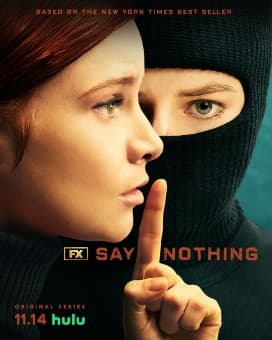
Poster / promotional material via Wikipedia, Say Nothing (TV series). Used under fair use for criticism and review.
Patrick Radden Keefe’s Say Nothing, published in 2018, is a book that operates at a specific, very difficult register. It is narrative nonfiction about the disappearance and killing of Jean McConville, a Belfast widow and mother of ten, by the Provisional IRA in 1972, and about the subsequent decades of silence, secrecy, and legal aftermath that followed. What makes the book extraordinary is not the reconstruction of the case but the texture of Keefe’s relationship to his sources and to the historical silence the book is attempting to puncture. Every page is a negotiation between what can be said on the record, what can be inferred, what remains unknowable, and what the writer is ethically entitled to claim.
This register does not translate automatically to television, and the question of whether the book should have been adapted at all has been, for me, the most interesting critical question raised by any prestige limited series of the last year. FX’s nine-episode adaptation, created by Joshua Zetumer and released on Hulu in November 2024, made me less sure of the answer than I was when the project was first announced. Not because the show is not good. The show is good. Because the book’s specific ethical texture is the thing that made the book what it was, and the adaptation, however skilful, cannot reproduce that texture.
What the adaptation chose to be
Zetumer’s show, directed principally by Michael Lennox and Anthony Byrne, is structured around parallel timelines: the 1970s Belfast of Dolours Price (Lola Petticrew young, Maxine Peake older), Marian Price (Hazel Doupe young, Helen Behan older), Brendan Hughes (Anthony Boyle young, Tom Vaughan-Lawlor older), and Gerry Adams (Josh Finan young, Michael Colgan older); and the later decades of legal reckoning, primarily around the Boston College oral-history project whose recordings, released after participants’ deaths, form the documentary spine of Keefe’s book.
The show is well-made. The production design is specific. The period detail, particularly in the Belfast scenes, is accurate at the level of particular kinds of wallpaper, specific street furniture, specific shades of brown. The direction is disciplined. The performances, particularly Lola Petticrew’s Dolours and Anthony Boyle’s Brendan Hughes, are among the best limited-series work of 2024.
What the show does well is stage the specific texture of Republican political commitment in 1970s Belfast. The Price sisters are depicted not as caricatures of terror-ideology but as specific young women making specific political-moral choices in the context of a war they believed, with their families and communities, was being waged against them. This is the correct choice and the necessary one. A lesser show would have flattened the politics. Zetumer’s show does not.
The Jean McConville problem
The book’s central ethical act is its treatment of Jean McConville. McConville is the murdered woman whose killing structures the entire historical reconstruction, and Keefe’s book handles her with a specific care: we are told what can be known about her, we are shown the specific shape of the silence that followed her death, and we are left in no doubt that the killing was a specific injustice done to a specific family by specific people.
The show handles McConville (played by Judith Roddy) adequately but with less specific weight than the book manages. This is, I think, a function of the medium rather than of the adaptation’s intentions. Television is a visual medium. It wants to show us McConville’s life. The book could let her remain partly unknowable, because print tolerates partial information better than screen does. The show has to give us scenes. The scenes are respectful. They are also, unavoidably, a kind of dramatisation of a woman whose life cannot be fully dramatised because it was too brutally truncated.
This is not a criticism the show could have solved. It is the cost of the adaptation. And it raises the question of whether, in this case, the cost was worth paying.
The Gerry Adams problem
The show’s handling of Gerry Adams, named directly, is the adaptation’s single most legally precarious element. Adams has consistently denied membership of the IRA. The book, drawing on the Boston College testimonies and other sources, depicts him as a senior IRA commander involved in the specific decisions that led to McConville’s killing. The show makes the same depiction.
I will not wade into the legal question. The show, to its credit, carries disclaimers. What is worth noting is that the show’s depiction of Adams, played by Josh Finan (young) and Michael Colgan (older), is one of the most politically serious television portraits of a living political figure in recent memory. Finan’s Adams is not a monster. He is a careful, specifically calculating political operator whose commitment to the struggle is shown as continuous with his later political evolution. The portrait is damning, but it is damning at the level of the whole human being, not at the level of caricature.
Michael Lennox, directing Belfast
Michael Lennox’s direction of the 1970s Belfast sequences is where the show’s specific visual intelligence is most active. Lennox is from Belfast. He knows the city at a level that a non-Northern Irish director would have had to research, and the specific texture of his staging, the way his camera moves through a Divis Flats corridor, the way he frames a British Army patrol from the perspective of someone watching from a window, is continuously authoritative.
The scene I want to single out is in episode three. Dolours Price and three other young Republicans are planning the 1973 Old Bailey car bombings. The scene is staged in a Belfast kitchen. The characters are making tea. The dialogue is operational, detailed, specifically banal in the way that operational planning is banal. Lennox shoots the whole scene in a single quiet master shot with occasional close-ups. Nobody raises their voice. Petticrew, as Dolours, is calibrating the specific tactical risk of the operation. The scene is the show at its best: it refuses the conventional visual language of terror-narrative, and instead treats the planning as an administrative meeting among specific young people making specific decisions they understand to be grave.
The Boston College sequences
The later-timeline Boston College material, which in the book is Keefe’s entry point into the secrecy at the heart of the case, is more awkward on television. The researchers (played by Rob Malone and others) are necessary to the show’s structural argument but are not, themselves, particularly dramatic. Zetumer handles this by keeping the Boston College scenes relatively brief, trusting the actors playing the older Price sisters and older Hughes to carry the emotional weight.
Maxine Peake’s older Dolours is the performance the show is, structurally, built around. Peake plays Dolours in her later years, after release from prison, after the end of the armed struggle, as a woman who has been asked, on tape, to describe what she did, and who is working out, in real time, what telling her story will cost. Peake is a specific British stage actor whose screen work has been increasingly good across the last decade, and her work here is the best screen performance she has given.
What the show does not, and cannot, do
The thing the book does that the show cannot do is sit inside the specific ethical question of whether the case should be written about at all. Keefe’s book continuously interrogates its own authority. Why should an American journalist write this book? What does it mean to take testimony from dead men via a Boston College archive whose subjects thought their recordings would be protected? What does the book owe to the McConville family, and what does it owe to the Prices?
The show does not have this register available to it. It has dialogue, performance, visual composition, montage. These are powerful tools. They are not tools for meta-textual ethical argument. The show can stage the events the book documents. It cannot stage the specific fact that documentation is itself a moral problem.
Was the adaptation worth making
My answer, after considerable thought, is qualified yes. The show brings the specific historical material to an audience that will not read the book, and it does so with enough care that the material is not disrespected. The show also loses something that the book had and that television cannot capture, which is the specific weight of the author’s own ethical self-interrogation. What the show adds, principally the visceral staging of specific Republican experience, is not nothing. But the trade is real.
What the season leaves
Say Nothing is, on its own terms, one of the better limited series of the last year. It is responsibly made. It is performed at a very high level. It will, I think, outlast most of the prestige television released alongside it.
Read the book first if you have not, and then watch the series. The two together are an argument about what history is for, and the argument is still being worked out.
Lena writes long-form essays on the films that will still be talked about in a decade. Previously at a defunct monthly whose name we do not speak.
MORE BY LENA ASHWORTH →
Dying for Sex: Michelle Williams, Jenny Slate, and the Limited Series as Vessel
Liz Meriwether's eight-episode FX series handed Michelle Williams the role of the decade and Jenny Slate the best supporting performance on television last year.

English Teacher: Brian Jordan Alvarez's Quiet Workplace Argument
Brian Jordan Alvarez's FX comedy arrived on Hulu in September 2024 and renewed quickly. The show is doing more than its loose register suggests, and the workplace logic is the reason.
Shōgun's Emmy Sweep and the Future of the Limited Series
Fifteen months after Shōgun's historic Emmy sweep, and with a second season confirmed, it's worth asking what the show changed about prestige TV, and what it didn't.