Pavements and the Joke That Turns Out to Be Sincere
Alex Ross Perry made four films about Pavement at once and braided them together. The braid should not hold. It holds, and somewhere in the middle it stops being funny and starts being true.
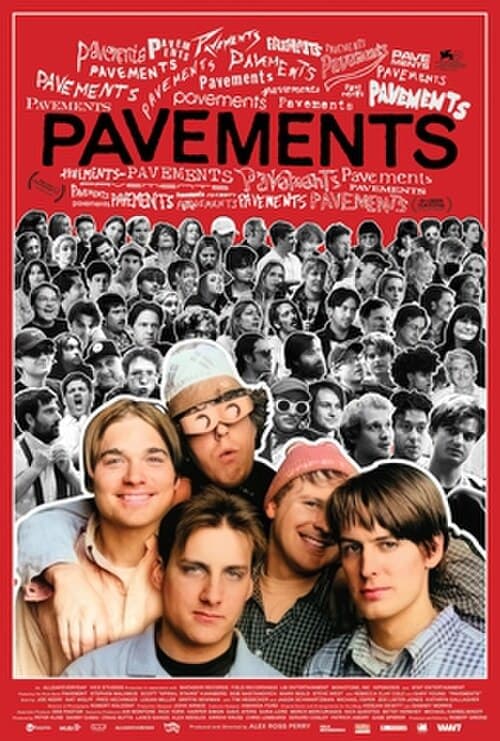
Poster via Wikipedia, Pavements. Used under fair use for criticism and review.
There is a moment in Pavements where I lost track of which film I was watching, and I think that was the plan.
Alex Ross Perry made his Pavement movie in 2024 by refusing to make one Pavement movie. He made four. There is a straight documentary, real footage of the real band reuniting for their 2022 tour, the actual Stephen Malkmus, the actual songs. There is a fake biopic, glossy and overwrought, with Joe Keery playing Malkmus as if auditioning for an Oscar he has already written the speech for. There is a museum, a genuine touring exhibit called Pavements 1933-2022, full of artefacts that are sometimes real and sometimes invented and never labelled which. And there is a jukebox musical, Slanted! Enchanted!, staging the band’s catalogue as earnest Broadway belters.
All four run at once. Perry cuts between them until the seams dissolve. It premiered at Venice in September 2024, runs 128 minutes, and Utopia put it out to the kind of audience that already owns the records.
The band that distrusted its own importance
You have to understand what Pavement were to understand why this is the only honest way to film them. They were a band built on a flinch. Every time Slanted and Enchanted or Crooked Rain, Crooked Rain threatened to become a Statement, Malkmus would undercut it, throw the melody away, mumble the line that should have been the chorus. The defining gesture of the band was a refusal to be caught caring in public.
So how do you make the reverent rock documentary about a band whose entire ethic was the rejection of reverence? You cannot. The straight version would be a lie. Perry’s answer is to build the lie on purpose, four times over, and let the audience watch the lie fail to contain the thing.
Keery is the engine
The biopic strand should be unbearable. It is shot like awards bait, scored like awards bait, and Keery commits to it completely, which is what makes it work. He is playing the version of Malkmus that a real biopic would invent, the tortured genius, the troubled visionary, and every frame of his performance is a small essay on how that template falsifies the people it claims to honour.
There is a fake behind-the-scenes layer too, Keery as an actor doing method research, taking the role too seriously, and the recursion gets dizzying. He is parodying the actor who parodies the musician. And then, in a couple of scenes, the parody slips, and you catch something real underneath, an actual feeling about an actual band, smuggled in under three layers of irony. That is the trick of the whole film. It hides sincerity inside so much performance that when the sincerity arrives you do not see it coming.
The museum is the thesis
I keep thinking about the museum. Pavements 1933-2022, the dates themselves a joke, a band that existed for about a decade given a span longer than most institutions. The exhibit treats indie-rock ephemera, set lists, a battered guitar, a flyer, with the hushed solemnity museums reserve for relics. Some of it is real. Some of it Perry fabricated. You are not told which.
That refusal to label is the closest the film comes to a manifesto. Pavement spent their career blurring the line between the throwaway and the carved-in-stone, and the museum extends the blur into the architecture of how we preserve a band. What deserves the glass case? Who decides? The exhibit asks the question and declines to answer, which is exactly what Malkmus would have done.
Why the braid holds
By rights this should collapse. Four films, none of them allowed to finish a thought before the next interrupts, a structure that sounds less like a documentary than a dare. It holds because Perry never lets any single strand win. The moment the real footage threatens to become straightforwardly moving, the musical barges in. The moment the musical threatens to become camp, the real Malkmus appears, older, funnier, still flinching, and grounds the whole apparatus.
The songs do the rest. Strip away the four frames and what is left underneath all of it is the actual catalogue, “Gold Soundz,” “Range Life,” “Cut Your Hair,” and the songs are strong enough to survive any framing you throw at them. That is the real argument Pavements makes, the one it is too cool to state outright. The band built things sturdy enough to be mocked, museumified, biopic-ed and Broadway-ed all at once and still come out the other side intact. You cannot kill a good song with irony. Pavement knew that. Perry built a whole film to prove it.
I came out not sure what I had watched. I am still not sure. I have listened to Crooked Rain three times since, which is probably the only review that counts.
Jules writes the kind of pieces that come from wandering somewhere and overhearing something. On Frame Junkie's masthead since the beginning.
MORE BY JULES OKONKWO →
The Record Springsteen Carried Around in His Pocket
A $55 million studio film about a man refusing to let a four-track demo turn into a studio record. The film took $45 million. The cassette had the better argument.

The Demo Singer Who Ended Up With the Number One Record
HUNTR/X are three drawings. Golden went to number one on the Hot 100 and won an Academy Award anyway, because the woman singing it had been doing this job in other people's names for years.
The X-Ray on the Cover of Virgin Is Not a Metaphor
Thirty-four minutes and fifty-one seconds, no cool-down, no exit ramp. Lorde's fourth record is the first one that sounds like a body instead of a report from one.