The X-Ray on the Cover of Virgin Is Not a Metaphor
Thirty-four minutes and fifty-one seconds, no cool-down, no exit ramp. Lorde's fourth record is the first one that sounds like a body instead of a report from one.
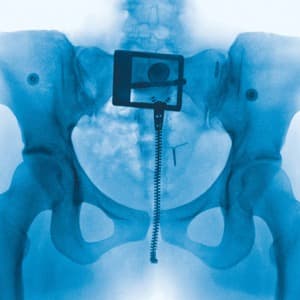
Album art via Wikipedia, Virgin. Used under fair use for criticism and review.
I heard “Hammer” for the first time in the back of a Camry on Parramatta Road, driver’s choice, volume set by somebody who did not know I was listening. The synth came in hard and low and the car’s speakers did the thing cheap speakers do, which is give up on the bottom end and hand you the top. I did not know what it was. I knew it was not being polite.
That is the record.
The runtime is the argument
Virgin came out on 27 June 2025 and runs thirty-four minutes and fifty-one seconds. Write that number down, because everything else follows from it.
Pop albums in 2025 were long. Streaming pays by the stream, so the incentive is to fill the tray, and the standard shape had become fourteen tracks with three that exist so the total goes up. Lorde turned in something you can listen to twice on a bus ride to the airport. There is no interlude. There is no track five that lets you go and make tea.
She opens with “Hammer”, which is three minutes and thirteen seconds and starts already moving, and follows it with “What Was That”, which was the first single back in April, and then “Shapeshifter”. Three songs in and you are eleven minutes deep with no landing yet. The sequencing does not let you catch up. That is not an accident of a short record. That is the design of a short record.
What Jim-E Stack does
She produced it with Jim-E Stack, with Dan Nigro and Buddy Ross also on the desk, and the sound is the first real break from Solar Power, which was four years earlier and made of acoustic guitar and afternoon light. This is synths, breakbeats, distorted guitar, a lot of low-mid that sits where a chest sits.
Solar Power was a record about being outdoors. Virgin is a record made entirely of interior weather, and you can hear the walls. Stack’s instinct throughout is to leave things slightly wrong. A synth that should be smooth is grainy. A kick lands with a bit of room noise on it that a cleaner producer would gate out. Critics reached for the word industrial and I understand why, but it is not industrial in the Nine Inch Nails sense. It is industrial in the sense that you can hear the machine that made it.
The vocal is the other break. She sings much closer to the microphone than she used to, and there are moments where the take is obviously the take, breath and all, no comp job smoothing the seam. Pop production in the last decade has spent enormous effort making voices sound like they were assembled. This one sounds like it was exhaled.
The picture on the front
The sleeve is an X-ray. People immediately read it as exposure, the confessional-album move, here-is-everything-about-me. I think that reading is upside down.
An X-ray is not a photograph of your inside. It is a photograph of your structure. It shows you the parts that hold you up and it deletes everything soft. That is what the record does. It is a short, structural, load-bearing album about a breakup, a move to New York, and a body she has been at war with, and it declines almost entirely to be tender about any of it.
Tenderness would be the soft tissue. She has taken it out.
What it did
It went to number one in Australia, in New Zealand, in Austria, in Scotland, and in the United Kingdom, which was the first time she had topped the UK albums chart in four attempts. It went top five in the United States. The Ultrasound tour started in September 2025 and runs through to September 2026, which is a long time to be on the road for thirty-five minutes of material, and every review of those shows says the same thing: the songs get longer live, and they get better longer.
There is one more fact that I keep coming back to. Virgin was the last thing she released through Universal Music New Zealand and Republic before she left Universal Music Group.
So the shortest, hardest, least accommodating record she has made is also the last one she owed anybody.
I do not think that is a coincidence and I do not think you have to be cynical to say so. Nobody makes a thirty-four-minute album with no exit ramp while they are trying to keep everyone happy. You make that record when you have decided the next conversation is going to happen somewhere else.
Back of a Camry, Parramatta Road, the top end of a bad speaker. It still got through.
Jules writes the kind of pieces that come from wandering somewhere and overhearing something. On Frame Junkie's masthead since the beginning.
MORE BY JULES OKONKWO →
Magdalena Bay's Imaginal Disk and the Slow Return of the Album
Magdalena Bay's second full-length arrived in August 2024 to a slow critical build and a fanbase already waiting. Five months on, the album is the strongest argument for the form in current pop.

Short n' Sweet: Sabrina Carpenter's Fully-Funded Year
A year on from Short n' Sweet, Sabrina Carpenter is the first pop star of her generation who has successfully metabolised the Disney-pipeline training into something that is not, finally, Disney.

Brat Summer: What Actually Happened
Charli XCX's Brat was the pop event of 2024. A year on, the question is not whether the record was good. The question is what Brat Summer actually was, who it was for, and why almost everything it inspired was bad.