Only Murders in the Building Season Four: The Los Angeles Problem
Hulu's Arconia comedy moved its fourth season to Los Angeles and brought a Hollywood satire with it. The season is the show's most uneven and reveals a specific structural tension the format was built to avoid.
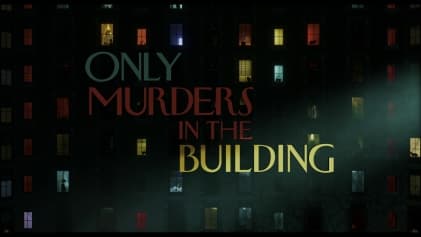
Poster / promotional material via Wikipedia, Only Murders in the Building. Used under fair use for criticism and review.
Only Murders in the Building returned to Hulu on 27 August 2024 for its fourth season across ten episodes, closing on 29 October. The season opens with Charles (Steve Martin), Oliver (Martin Short), and Mabel (Selena Gomez) being courted by a Paramount film adaptation of their podcast, moves them to Los Angeles for most of its run, and deploys a guest cast that includes Eugene Levy, Eva Longoria, Zach Galifianakis, Kumail Nanjiani, Molly Shannon, and Melissa McCarthy. Meryl Streep returns from the third season. Meryl is the glue.
The season has been the show’s most commercially visible (the Paramount premise invited precisely the kind of press-junket circuit the third-season run had not), and it has also been, in my assessment, the show’s least successful as a mystery and as a character piece. The Los Angeles shift is the specific decision that created both effects.
The format the show built
John Hoffman and Steve Martin’s original conception, across the first three seasons, was specifically structural. The Arconia, the fictional Upper West Side pre-war apartment building that gives the show its name, functioned as both set and formal constraint. Each season’s mystery had to be solvable using the building and its residents as the information pool. The walls were load-bearing. The neighbours were suspects and suspects were neighbours. The three protagonists, cloistered inside their vertical dramatic world, had to work out the truth through conversation, surveillance, and the specific social archaeology of a shared building.
This structural constraint produced the show’s specific pleasures. Character revelation came via elevators, shared hallways, and back-stairwell encounters. Comic timing came from the claustrophobia. Mystery solution came from the patient re-examination of the same physical space. The Arconia was the genre engine.
What Los Angeles does to the engine
The fourth season retains the Arconia setting for its first two episodes (the murder occurs in the building, Sazz Pataki’s body is found in Charles’s apartment, the specific fact pattern of the new case is established) and then relocates the investigation to Los Angeles in episode three. The Paramount adaptation meta-premise is the transport mechanism. Zach Galifianakis plays a film director attempting to adapt the podcast; Eugene Levy, Eva Longoria, and Zach Galifianakis play actors auditioning to play Charles, Oliver, and Mabel respectively.
The comic register of the Los Angeles material is often excellent. Short is especially funny in the meta-production scenes (Oliver’s specific insecurities about being adapted produce some of the season’s best standalone beats). The industry satire is knowing without being inside-baseball in a way that would lose the broader audience. The guest stars, and particularly Molly Shannon as a studio executive, are enjoyable.
The mystery stops working. The season is investigating a contract killer named Sazz Pataki (Jane Lynch, returning in flashback) and the specific reasons for her death at Charles’s apartment. The investigation requires the protagonists to shuttle between Los Angeles and New York; the specific social archaeology the show is built on requires them to be in one building; the format cannot sustain both demands at once. By the season’s midpoint, the mystery has fragmented into a set of disconnected geographic scenes that never reconstitute into the specific solvable-by-rewatching configuration the show previously delivered.
The Sazz problem
Sazz Pataki, Charles’s long-time stunt double, was established across the first three seasons as a recurring minor character played by Jane Lynch. The decision to centre the fourth-season mystery on her death, which is in principle a smart character-driven move (a victim the protagonists knew, rather than a victim they had to investigate cold), works in the first two episodes and then runs into a structural obstacle.
The show has told us, across three seasons, that Charles and Sazz were close. The fourth season needs Charles to grieve Sazz. Steve Martin’s specific comic register is not especially suited to grief and the show has not, in its first three seasons, built the emotional vocabulary for sustained loss. When the season asks Martin to carry grief as a dramatic through-line across ten episodes, the register that comes out is a specifically under-tooled mix of sad Steve Martin and stoic Steve Martin, neither of which is the Steve Martin the character has been for three seasons.
The show’s writers know this. The compensatory move, which I think is the season’s most interesting gesture, is to split Sazz’s functional role across two characters: Sazz herself, seen in flashback, and a new character (Bev Melon, played by Molly Shannon) who functions as a kind of acoustic shadow of Sazz. The move is clever. It does not quite work, but the fact that the show tries to compensate at all suggests the writers diagnosed the grief problem and attempted a structural solution.
The West Tower discovery
The single best decision of the season is the introduction of the West Tower residents. The Arconia’s second tower, previously invisible in the show’s geography, contains a community of residents who have been living next to the podcast protagonists for three years without appearing on the podcast. Meryl Streep’s Loretta, Richard Kind’s Vince Fish, and a new set of West Tower characters (Kumail Nanjiani, Melissa McCarthy, Siena Werber) form a kind of mirror community with their own gossip networks, their own politics, and their own specific weight as potential suspects and information sources.
This is the specific structural move the format needed. By introducing a new community inside the Arconia itself, the show creates a second set of vertical social relationships without leaving the building. The mystery gains a new information pool without the Los Angeles detour, and the West Tower material, across episodes seven and eight, produces the season’s single best sustained mystery sequence.
The problem is that the West Tower is introduced too late. The first two-thirds of the season has been spent on the Los Angeles material; by the time the West Tower comes into focus, the season’s momentum has been partially spent on a subplot that does not fully pay off.
Selena Gomez as Mabel
Gomez has, across the four seasons, done the specific work of holding the show’s tonal centre between Martin’s and Short’s larger performances. Mabel is the character whose interior life the writers have consistently developed most carefully; Gomez plays her with the specific restraint the two older actors’ comic energy requires. The fourth season continues this work and adds a specific new register: Mabel in her late twenties, newly domestic in a Brooklyn apartment, considering what a life outside the Arconia might look like.
This is, in the abstract, exactly the character work the season needed. In execution, the Mabel-in-Brooklyn material is under-developed. The show has built a specific relationship between Mabel and the Arconia (she inherited her apartment from an aunt, her adult life has been shaped by the building) and the question of what happens when she leaves deserves a more patient treatment than a single-episode visit allows. The season introduces the premise and does not fully investigate it.
What the season is actually arguing for
The fourth season’s central tension, as I read it, is the show’s own question about whether it can sustain itself. The meta-premise (the podcast becoming a Paramount film) is the writers asking, in the text, whether the show’s own format can scale to the commercial attention the show has attracted. The answer the season gives, via the specifically uneven Los Angeles run, is that the format resists the scaling. The Arconia cannot be a movie. The Arconia is the show.
This is a genuinely interesting thing for a fourth-season mystery comedy to be asking, and the season deserves specific credit for asking it. The season is, as mystery, less than the third. As character comedy, it is uneven. As formal self-reflection, it is the most interesting work the show has produced.
What to watch for in season five
The fifth season has been ordered. The murder at the end of the fourth season is a specific structural bet: the victim is Lester, the Arconia doorman, whose death returns the show to its original building-centred premise and releases the Los Angeles material as a completed parenthesis. If the writers use the reset to return to the tighter Arconia-bound format of the first three seasons, the fourth season’s experiment will read, retrospectively, as a productive detour. If they do not, the show’s format exhaustion will become the subject rather than the frame.
I want the fifth season. I would rather have the third season’s mystery engineering back, though, than another Hollywood detour. The Arconia is still the best set on American television for the specific kind of vertical comedy this show does. The writers know it. The fifth season needs to know it.
Priya came to criticism sideways from theatre. She is patient with slow shows, short with bloated ones, and cheerfully vicious about lazy writing.
MORE BY PRIYA NAIR →
The Residence: Uzo Aduba, Shondaland, and the Detective as Structure
Shondaland's White House whodunnit handed Uzo Aduba the role she has been waiting for since Orange is the New Black. The rest of the show is trying to catch up to her.

English Teacher: Brian Jordan Alvarez's Quiet Workplace Argument
Brian Jordan Alvarez's FX comedy arrived on Hulu in September 2024 and renewed quickly. The show is doing more than its loose register suggests, and the workplace logic is the reason.

The Studio Makes the Long Take Mean Something
Most television uses the unbroken take to show off. The Studio uses it to trap its lead inside his own disasters, which is the most honest thing a Hollywood comedy has done in years.