Nilüfer Yanya's My Method Actor and the Uses of a Third Record
Nilüfer Yanya's third record arrived in September 2024 as the specific consolidation work a third album is supposed to do, and the consolidation has produced the strongest writing of her career.
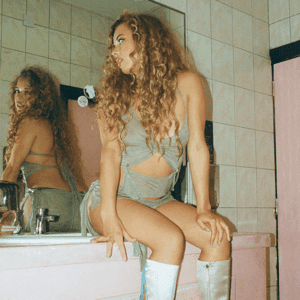
Poster / promotional material via Wikipedia, My Method Actor. Used under fair use for criticism and review.
Third records are, in the logic of album-oriented rock, a particular kind of problem. The debut establishes a voice. The second record reckons with the fact of having made a debut. The third has to arrive at a specific consolidation, a specific understanding of the form the voice will work inside, or the artist begins a slow drift toward indistinction. Nilüfer Yanya’s third record, My Method Actor, released on Ninja Tune on 13 September 2024 across twelve tracks and roughly forty-three minutes, is the specific consolidation work her first two records had been circling toward. It is also, measured against the first two, the strongest writing of her career.
The first two records
Yanya’s debut, Miss Universe (2019), was a confident first record that used a concept-album architecture (a fictional wellness brand narrating between tracks) to hold together a stylistically wide set of songs. The record was praised and variously cited as drawing on Jeff Buckley’s phrasing, Sade’s cool register, and the 1990s UK jazz-inflected indie-pop shelf. The stylistic breadth sometimes meant individual songs were reaching for different formal solutions and the record did not always settle.
Painless (2022) narrowed the palette. Leaner, guitar-led, less interested in the conceptual architecture the debut had built. The narrowing was useful. Painless was the record Yanya needed to make in order to find out what her guitar-led register could sustain. It still felt provisional, a set of proofs-of-concept rather than a settled statement.
My Method Actor is the settled statement. It extends Painless’s sonic narrowing and adds a structural coherence the earlier records did not sustain across their full run.
What the record sounds like
The sonic centre is Yanya’s guitar work and her vocal phrasing, and both have matured. The guitar playing is clean, rhythmic, often running in a double-tracked register that gives the songs density without a wider instrumentation. The vocal phrasing has moved away from the Buckley-adjacent melisma of the debut toward a conversational register closer to 1990s Liz Phair or to Cate Le Bon than to the touchstones the early coverage cited.
The rhythm section, handled mostly by co-producer Wilma Archer, sits in a register that is not quite shoegaze, not quite indie-rock, not quite the 1990s trip-hop shelf the production occasionally gestures toward. The drums are programmed with attention to the way live drums would breathe inside the mix. The bass is low and patient. The rhythm section refuses to hurry the songs. Yanya’s writing benefits from a patient accompaniment, and Archer knows it.
What Wilma Archer does
Archer, whose production work across the last decade has been quietly distinguished, is the collaborator who has given My Method Actor its coherence. He is credited as co-producer and co-writer across all twelve tracks. The co-writing credit matters. The record is not a producer-overlay on a set of Yanya demos. It is a working partnership in which the songs have been built inside the collaboration rather than delivered to it.
What Archer brings is a restraint about production. The record does not lean on the post-Billie Eilish close-mic whisper register that has dominated a particular strand of current indie. It does not lean on the maximalist-arrangement register the Jack Antonoff shelf has produced. It leans on a middle register that gives each song a distinct arrangement without exhausting the record’s overall coherence. The production is in service of the songwriting. This is increasingly rare.
The songwriting
The writing is the strongest of Yanya’s career. The songs are built around specific emotional situations rendered with clarity. Yanya is writing, across the record, about the experience of being inside relationships (romantic, artistic, self-directed) that require a kind of performance, and the title does the work of pointing at the question. What does it mean to act methodically inside an emotional situation? How does the method merge with the actor? The songs are not essays on these questions. They are small stagings of the questions inside particular scenes.
“Like I Say (I Runaway)”, the opening track, sets the register the record will sustain. A repeating guitar figure and a vocal phrase that returns with variation across the track’s length build an incantatory shape that does not resolve. “Mutations”, the second single, is structured around a guitar arrangement that shifts register three times across the track. The shifts are the song’s emotional architecture; the vocal follows them without over-announcing. On repeated listening, it is the moment the record is most formally ambitious.
“Call It Love” is the track I would play for someone who had not heard the record: legible on first pass, melodic, restrained in its production in a way that shows what the record does across its other tracks. “Faith’s Late” closes the record with a patience that pays off the earlier tracks’ accumulated weight. The closing instrumental passage is the record’s emotional exhalation.
The space around the voice
The specific production choice worth marking is how the record handles space. The songs are mixed with room around Yanya’s voice. The room is not a reverb effect; it is a decision about how dense the arrangements should be behind the vocal. Most current indie production over-fills the space. My Method Actor deliberately under-fills. The decision gives the record its emotional clarity.
A second choice: the handling of the guitar-and-drum interplay. The rhythms are built around a tension between Yanya’s guitar (which often plays against the beat) and the programmed drums (which sit inside it). The tension is the rhythmic interest the record runs across its twelve tracks. A lesser production would have resolved the tension. Archer keeps it unresolved, and the tension is what keeps the tracks legible as individual pieces inside the album’s whole.
What the record argues
The argument the record makes, by existing and by working, is that the third-record consolidation problem is solvable if the artist has collaborative patience and writing discipline. Yanya is not trying to out-scale her second record. She is not trying to out-ambition her first. She is trying to arrive at the register she has been circling toward, and the record is the proof that she has arrived.
The broader argument is that indie-rock as a category, which has been in a slow critical decline across the last five years, still contains artists doing craft work at a specific level. The category has been hollowed by economic pressures on mid-scale indie (reduced label budgets, reduced touring margins, reduced critical infrastructure). My Method Actor is made inside those pressures and is better work for them rather than diminished by them.
The live work
I saw Yanya at Sydney’s Factory Theatre in November, two months after the record’s release. The live show corroborated the record’s craft claim. The four-piece band performed the record with attention to the album’s arrangements. The songs worked live without needing rearrangement. The crowd, modest but committed, held attention across the ninety minutes. The show sounded like the record. For a specifically produced indie record, this is an achievement. Many artists with production at this level cannot bring it into the live room. Yanya can, and the ability is the evidence that the record’s production was built around the songs rather than around the studio.
Where it sits
My Method Actor is, in my view, one of the three or four best indie records of 2024. It will not receive the attention the year’s pop-crossover projects will. The scale at which Yanya operates, the label infrastructure behind the record, and the absence of a crossover-single moment mean the record will not produce the streaming-era metrics other 2024 records have produced. This does not matter on the craft level. The record is specifically made. It rewards the slow attention the album form was built for. It consolidates an artist’s first decade of work into a settled statement. It will, across the next decade, sound better than the year’s more visible records.
Put the record on tonight. Start at track one. Let the guitars do their work.
Lena writes long-form essays on the films that will still be talked about in a decade. Previously at a defunct monthly whose name we do not speak.
MORE BY LENA ASHWORTH →
Mk.gee's Two Star & the Dream Police: The Guitar Record the Year Needed
Mk.gee's debut full-length is the strangest guitar record a twenty-something American songwriter released in 2024, and nine months in it is still rewiring what popular guitar is allowed to sound like.
Magdalena Bay's Imaginal Disk and the Slow Return of the Album
Magdalena Bay's second full-length arrived in August 2024 to a slow critical build and a fanbase already waiting. Five months on, the album is the strongest argument for the form in current pop.
The X-Ray on the Cover of Virgin Is Not a Metaphor
Thirty-four minutes and fifty-one seconds, no cool-down, no exit ramp. Lorde's fourth record is the first one that sounds like a body instead of a report from one.