The Alto Knights: De Niro Twice, and Nobody Once
Barry Levinson's mob drama had a Goodfellas screenwriter, a great cinematographer, and Robert De Niro playing both leads. It grossed 9.6 million dollars. Here is why.
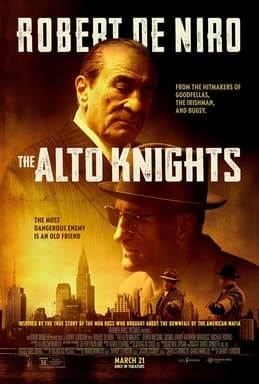
Poster via Wikipedia, The Alto Knights. Used under fair use for criticism and review.
Let me get one thing out of the way. The Alto Knights is not an incompetent film. It was directed by Barry Levinson, who has an Oscar. It was written by Nicholas Pileggi, who wrote Goodfellas and Casino. It was shot by Dante Spinotti, who has photographed some of the best-looking American films of the last forty years. And it stars Robert De Niro, who is Robert De Niro. On paper this is a rich man’s mob movie, made by people who have done it before and done it well.
It grossed a reported 9.6 million dollars worldwide against a budget reported between 45 and 50 million. Warner Bros released it on 21 March 2025 and it was gone almost before anyone noticed it had arrived. I say what follows with no pleasure, because I would rather live in a world where a studio still spends fifty million on a Pileggi script for grown-ups. But the failure of The Alto Knights is not a mystery, and pretending it is does the film no favours. The film tells you why it failed in its first ten minutes. It just does not know that it is telling you.
The gimmick is the tell
De Niro plays two men. Frank Costello, the diplomat of the New York rackets, the boss who wanted to run crime like a business. And Vito Genovese, the paranoid rival who tried to have Costello killed in 1957 and botched it. These were real men, and their feud is real history, and it is good material. The 1957 hit, where a gunman put a bullet along the side of Costello’s skull and Costello lived, is one of the great near-misses in American organised crime.
So here is the question the film never answers: why is one actor playing both of them? Not for any reason the story requires. Costello and Genovese share scenes, and in those scenes you are watching De Niro act against De Niro, one of them buried under prosthetics that turn a seventy-nine-year-old into a different seventy-nine-year-old. The stunt is not illuminating. It is distracting, in the specific way that makes you think about the makeup department instead of the men. And it points at the thing underneath the whole production: they could not, or would not, cast a second star.
When you cannot get a second lead, you photograph your one lead twice and call it a bold choice. Al Pacino across the table from De Niro is a movie. De Niro across the table from a latex De Niro is a curiosity. The film mistakes the second thing for the first, and audiences, who are better at reading these signals than the industry gives them credit for, smelled the substitution from the trailer.
A film with no reason the audience could feel
Pileggi’s Goodfellas had Henry Hill, a rat with a pulse, narrating us through the seduction and the rot. Casino had greed and Sharon Stone burning the whole thing down. Both films had a reason to exist that a viewer could feel in the first reel: this is what the life gives you, and this is what it takes back. The Alto Knights has two old men litigating a decades-old grievance in rooms, and Levinson shoots it like a deposition. Spinotti makes the rooms handsome. Douglas Crise cuts them cleanly. David Fleming’s score does its job. None of it answers the only question that sells a ticket, which is: why now, and why should I care.
The film is set among men whose era is ending, and it knows that, and it keeps telling us that, and the telling is the problem. A movie about the twilight of the old mob has to make the twilight ache. This one narrates the ache instead of dramatising it. There is a lot of voiceover. There is a lot of sitting. There is a running sense that everyone involved assumed the material would carry itself because it had carried Scorsese, and forgot that Scorsese brought propulsion the material does not supply on its own.
The audience that did not come
Here is the industrial reality, and it is not the film’s fault, though the film walked into it with its eyes shut. The mid-budget adult drama, the fifty-million-dollar movie for people over fifty, is the single most endangered animal in the American cinema. The audience that would once have made The Alto Knights a modest hit now waits eight weeks and watches it at home, and they are right to, because the film gives them no reason to leave the house. There is no spectacle. There is no event. There is no performance the trailer could not already show you, because the performance is the gimmick and the gimmick was in the trailer.
Warner Bros knew this. You can tell they knew it by the way they released the film, quietly, into a spring weekend, with a campaign that led with the dual role because the dual role was the only thing to lead with. When the marketing hook and the artistic misjudgement are the same decision, the film was lost at the script stage.
What it should have been
There is a good film hiding in here, and it is not a two-hander played by one man. It is Costello, alone, the boss who wanted to go legitimate, watching the world he built get taken by a paranoid who could not be reasoned with. Give Genovese to another actor and you have a study of two philosophies of power, the diplomat and the brute, embodied by two different faces the way two philosophies should be. Levinson and Pileggi had that film available to them. They chose the trick instead.
The Alto Knights is a well-made picture with a hole where its reason should be, and audiences find those holes faster than critics do. Nine point six million dollars is not a verdict on Barry Levinson’s competence. It is a verdict on a choice: that a star doubled is worth more than a story felt. It is not, and the returns are the receipt.
Marcus believes good criticism is an argument. He is almost always angry about something, usually for good reason. Horror is his first language.
MORE BY MARCUS VELL →
Superman Had to Launch a Universe and Be a Film at Once
James Gunn's Superman was carrying a whole rebuilt DC on its back and still had to be a movie for two hours. It managed both, and the strain shows in exactly one place.
The Running Man Spent Like a Star Vehicle Without a Star
Edgar Wright's Stephen King adaptation took $69 million worldwide on a $110 million budget. The film was fine. The price tag assumed a star Paramount had never actually tested.
Borderlands and the Three Years Lionsgate Sat On It
Eli Roth's Borderlands cost a reported $110 million and grossed about $33 million worldwide. The film is bad. The thing that made it a disaster happened in the edit room, three years before release.