GNX and the Kendrick Lamar Surprise-Release Argument
Kendrick's surprise-dropped November record is the victory-lap album that also functions as a genealogy lesson. Both registers are doing specific work, and both work.
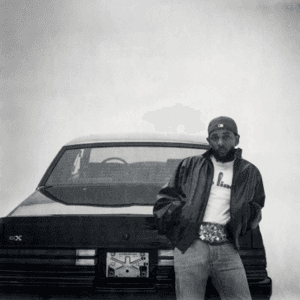
Poster / promotional material via Wikipedia, GNX (album). Used under fair use for criticism and review.
Kendrick Lamar surprise-released GNX on 22 November 2024, with no pre-announcement and no lead single. The record arrived on streaming services on a Friday morning, Los Angeles time, and by the end of the following day it was the dominant conversation across every music-adjacent channel in North American pop culture. The release mechanics were the first argument the record made, and the mechanics worked.
GNX is the second album Kendrick has released in 2024 if you count Mr. Morale & the Big Steppers as the 2022 record it technically is and We Cry Together not as an album but as the extended track it functions as. It is the first Kendrick full-length since the Drake-feud beat cycle that dominated the first half of 2024 (Like That, Euphoria, Meet the Grahams, Not Like Us, 6:16 in LA), and it is in specific dialogue with that cycle without being reducible to it. This is the first thing worth noting about the record.
What the record is
GNX runs 44 minutes across 12 tracks. It is produced primarily by Mustard, Sounwave, Jack Antonoff, and Kendrick himself, with additional production from Sean Momberger, Craig Balmoris, Ray Charles Brown Jr., and others across the credits. The features list includes SZA (on “luther” and “gloria”), Dody6, Lefty Gunplay, Peysoh, Young Threat, Hitta J3, AzChike, Wallie the Sensei, and Roddy Ricch. The feature selections are substantial. Most of the featured artists are specifically Los Angeles-based, several from the specific Compton geography Kendrick has continued to centre across his catalogue, and a few are relative unknowns whose placement on the record has obvious career implications.
The title refers to the Buick Grand National GNX, a specific high-performance American muscle car manufactured in limited numbers between 1987 and 1989. The car was produced the same year Kendrick was born. The choice of title is the second thing worth noting. The record is, among other things, a specifically constructed object about the specific Los Angeles inheritance Kendrick has claimed across his career.
The victory-lap argument
I want to address the specific critical frame that dominated the record’s initial reception, which is that GNX is a victory-lap album. This is partially correct and partially the wrong frame.
It is correct that the record arrives in the specific wake of the Drake feud cycle, that several tracks explicitly or obliquely reference the cycle, and that the record’s general emotional temperature is one of sustained confidence. “wacced out murals” opens the record with a specific mode of self-possessed grievance that reads as the victorious artist clearing the decks before moving on. “squabble up” and “hey now” run through the same register. “tv off” closes the aggressive first movement of the record with a Mustard production that borrows the specific anthem-structure of Damn.-era Kendrick while pushing it into a specifically harder trap register.
But the victory-lap frame undersells what the record is doing structurally. The second half of the record, beginning around “reincarnated” and extending through “gloria,” is substantially more interior, more genealogically focused, more concerned with the specific lineage Kendrick is claiming than with the specific feud he has just exited. The record is not only, or even primarily, a response to the first half of 2024. It is a longer-horizon claim about what Kendrick’s specific position inside West Coast hip-hop is and what he intends to do with the position.
Mustard, specifically
Mustard’s production dominates the record’s first movement, and the dominance is the record’s first significant formal argument. DJ Mustard, whose work across the 2010s (I Love Mustard, Perfect Ten) established a specific hyphy-adjacent West Coast production register, had moved away from the specific dominant-producer position he occupied mid-decade. His placement across “tv off,” “hey now,” and other tracks on GNX is a specific argument about the continuing vitality of the West Coast production lineage Mustard has been working inside.
The specific Mustard beat on “tv off” is the track that broke through on short-form video platforms within the first forty-eight hours of the record’s release. The “MUSTARRRRRD” ad-lib, delivered by Kendrick in the track’s bridge, became the specific sonic artifact that travelled fastest. This is the kind of craft-level detail (the producer tag, used as a rhythmic device inside the song) that specific hip-hop culture has always understood and that the wider pop-music culture is often slow to register as meaningful.
The genealogy tracks
The record’s deeper argument is distributed across several tracks that operate at a specific genealogical register. “reincarnated,” produced by Sounwave and Jack Antonoff, positions Kendrick inside a specific lineage of previous West Coast artists. The verse structure, which moves through a specific second-person address across three implied historical figures, is the record’s most lyrically ambitious stretch. The track is doing the specific work of claiming inheritance, and the claim is substantively argued.
“dodger blue,” featuring Wallie the Sensei, Siete7x, and Roddy Ricch, is the record’s most openly Los Angeles-location track. The reference set is specific: Chavez Ravine, the Brown Berets, the specific 1950s displacement that created the stadium the Dodgers now play in. This is the kind of specific historical-political reference that Kendrick’s catalogue has always included but that GNX is unusually direct about.
“gnx,” the title track, features Hitta J3, YoungThreat, and Peysoh, and operates as the record’s clearest statement of the specific Los Angeles-local artistic inheritance Kendrick is claiming. The featured artists are not major-label placements. They are specific local Los Angeles-area hip-hop figures whose inclusion on the record is the argument the title track is making.
The SZA tracks
“luther” and “gloria,” the two SZA features, are the record’s emotional anchors. “luther,” built around a specific sample of the Luther Vandross and Cheryl Lynn duet “If This World Were Mine,” is the track the record’s pop-radio life is organised around. The SZA-Kendrick vocal-pairing dynamic, established across Ctrl and subsequent collaborations, is more developed on “luther” than on any previous joint track. The vocal register is patient, careful, willing to sit inside a specific kind of quietness that neither artist’s solo material often commits to at this length.
“gloria” closes the record. It is the longest track, it is the least structurally conventional, and it is the track the record’s argument has been building toward. I will not describe the specific lyrical content in detail. The track is a specific statement about creative partnership, about a specific female muse, about the specific long-form inheritance Kendrick has been claiming across the record. The closing is the correct closing.
The performance year
GNX has lived, across its commercial life, alongside a sustained performance schedule that included the 9 February 2025 Super Bowl LIX halftime show, in which Kendrick performed a twelve-minute setlist built around GNX material alongside the Drake-feud tracks. The halftime show was reported to have drawn the largest audience in Super Bowl halftime history, and the specific visual choreography of the performance (the dance company work, the specific staging of “Not Like Us,” Samuel L. Jackson’s recurring Uncle Sam interventions) was the specific kind of large-format artistic statement that the record had been setting up.
The tour, the Grand National Tour with SZA that began in late April 2025, is the continuation of the same argument in a different form. The tour is built around the two artists’ specific joint material, which GNX has substantially expanded.
What the record is, after six months
GNX has accumulated critical and commercial weight across the first half of 2025 at a specific rate that its surprise release did not fully predict. The record spent its opening weeks at the top of the American albums chart, produced three tracks (“squabble up,” “tv off,” “luther”) that entered the top ten of the singles chart, and has sustained streaming numbers across the subsequent months at levels consistent with Damn. and Mr. Morale at the equivalent life-cycle points.
What the record will look like in five years, I think, is the album-length completion of the specific argument the Drake-feud singles were making at track-length. The feud established Kendrick’s specific rhetorical position. GNX translates the rhetorical position into a sustained artistic statement. The two are complementary, and a five-year retrospective of the 2024-2025 Kendrick cycle will, correctly, read them as a single project rather than as separate releases.
Put the record on in full. Start with “wacced out murals” and do not skip. The specific pacing, from aggressive opening movement through genealogical middle stretch through SZA-inflected closing two tracks, is the specific design the record is built around. The design works. Kendrick’s catalogue, at this point, is a continuous document, and GNX is the most recent legible chapter.
Jules writes the kind of pieces that come from wandering somewhere and overhearing something. On Frame Junkie's masthead since the beginning.
MORE BY JULES OKONKWO →
Only God Was Above Us: Vampire Weekend at Full Power
Vampire Weekend's fifth album, released in April 2024 after a five-year wait, is the record where the band finally stopped being a band about youth. A year on, the shift is the interesting thing.

Short n' Sweet: Sabrina Carpenter's Fully-Funded Year
A year on from Short n' Sweet, Sabrina Carpenter is the first pop star of her generation who has successfully metabolised the Disney-pipeline training into something that is not, finally, Disney.

Brat Summer: What Actually Happened
Charli XCX's Brat was the pop event of 2024. A year on, the question is not whether the record was good. The question is what Brat Summer actually was, who it was for, and why almost everything it inspired was bad.