Mahashmashana and the Long Father John Misty Project
Josh Tillman's sixth Father John Misty record arrived in late November on Sub Pop. It is the longest the project has sounded and, in a specific way, the least defended.
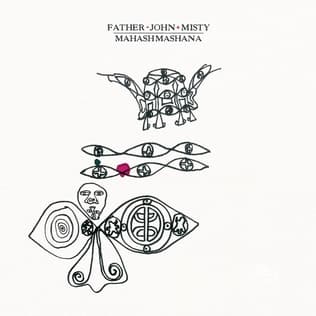
Poster / promotional material via Wikipedia, Mahashmashana. Used under fair use for criticism and review.
Mahashmashana came out on Sub Pop and Bella Union on 22 November 2024. It is the sixth Father John Misty record, Josh Tillman’s project since 2012, and it runs about fifty minutes across eight tracks. The title is Sanskrit, roughly, the great cremation ground. The record is the longest, most orchestral, and, I think, the most emotionally unguarded record Tillman has released under the Father John Misty name.
I saw him on the short touring cycle that followed the release, twice, once in Sydney in February and once in Melbourne the night after. The live arrangements, a nine-piece band with strings and horns, made clear what the record is doing. The record is asking to be heard all the way through, at length, with the arrangements honoured. It rewards the asking.
The specific project, by now
Father John Misty has been, since Fear Fun in 2012, a project about Josh Tillman’s relationship with his own literary persona. I Love You, Honeybear (2015) was the falling-in-love record. Pure Comedy (2017) was the state-of-the-world record. God’s Favorite Customer (2018) was the dissolution record. Chloë and the Next 20th Century (2022) was the pastiche record, a set of standards-form songs about a Hollywood that is partly real and partly invented. Each of these has a specific formal commitment and a specific emotional posture. The posture has, through most of the project’s lifetime, been ironic.
Mahashmashana is the record where the irony gets quieter. The persona is still present. The register is still literate. The sentences still have the Tillman specific rhythm, the long unfurling subordinate clauses that resolve in a dry joke or an unexpectedly sincere line. What is different is the distance between Tillman and the persona. On the earlier records the ironic remove was the structural device. Here the device has been metabolised. Tillman is writing closer to himself, and the closer writing is the record’s argument.
The production
The record was produced by Tillman with Drew Erickson, who has been the project’s arranger since Chloë. The band is deep. The orchestral arrangements are the thickest the project has used. The string writing, in particular on the title track and on “Screamland,” is not decoration. It is the song’s structural engine in the way strings are on the best Scott Walker records or on the Jon Brion arrangements for early Fiona Apple. Erickson is a specific talent. The string work here is among his best.
The recording is live-band, with overdubs, in a specific mid-period studio register. The drums are live and loose. The electric guitars, mostly Dave Nelson, are mixed lower than on previous records, giving the strings and Tillman’s voice room. The vocal is recorded warmly and placed slightly in front of the mix. The vocal is the lead instrument. It was always going to be.
The songs, in sections
The record is not track-by-track in the conventional sense. It is assembled as a long suite. The eight songs break into three structural sections, which the live set honoured and which I think reward the attention.
The first section, “Mahashmashana” and “She Cleans Up,” is the record’s thesis. The title track is a nine-minute orchestral piece built around a single melodic idea that resolves, across the length, into something that reads as both a death-register meditation and a specific autobiographical confession. “She Cleans Up” is the more propulsive counter-track, a character-song about a woman who survives the male disaster around her. The two songs bracket the record’s two registers, the orchestral-meditation and the character-song, and tell the listener what the record will be doing.
The middle section, “Josh Tillman and the Accidental Dose,” “Mental Health,” and “Screamland,” is the record’s interior. The title of the first of these is the longest-running Father John Misty joke made explicit: Tillman’s legal name is also his performer name when he wants it to be. The song is about an accidental overdose and the specific emotional aftermath. It is one of the two or three best songs he has ever written. “Mental Health” is the companion piece, a direct-register account of a psychiatric crisis that the earlier records would have approached obliquely. “Screamland” closes the section with the big orchestral catharsis. It is the song that most divided the reviews. I am on the side that thinks it works. The excess is the point. The song is designed to be excessive because the emotional material is.
The third section, “Being You,” “I Guess Time Just Makes Fools of Us All,” and “Summer’s Gone,” is the record’s resolution. These are the quieter songs. “Being You” is a love song to his wife that the record gives room. “I Guess Time” is the record’s country-inflected track and, in the live set, the song Tillman introduced with the longest spoken preamble. “Summer’s Gone” is the closer, a small finite meditation that ends the record without a large gesture. The decision not to end on a gesture is a good one. The record has already done the large gestures. The closer is earning the quiet.
What has changed, in Tillman’s voice
The voice on this record is different. The specific change is in the phrasing. Tillman has always been a careful phraser; the records before this one worked with a long-form declamatory delivery that was occasionally mannered. On Mahashmashana the phrasing is slower, the vibrato is more controlled, and the specific emotional weight of individual lines lands differently. The vocal is less performed and more reported.
This is, I think, the vocal sound of a singer who has spent the tour cycles since 2018 working the songs live and learning them from inside. Tillman’s live performances across the Chloë cycle were the strongest I had seen him do. The record that follows that tour cycle is the record of a singer who has a better sense of where his voice actually lives.
The live show, as gloss
The Sydney show was at the State Theatre. The nine-piece band, the string section, the horns, the specific stagecraft of Tillman’s lectern and his suit. The set was built around the record with a thin cushion of older material. The old songs, sung by the current-voice Tillman, read differently than they did on the records. “Real Love Baby,” for example, was slower, more considered, less performed. The audience, which at the State Theatre skews older and more attentive than most festival crowds Tillman plays, gave the new material the close listening it is designed for.
The Melbourne show, the next night, was tighter and stranger. Tillman’s between-song patter, which is one of the project’s ongoing pleasures, was sharper. The performance of “Mental Health” in Melbourne was the best single piece of live music I have seen this year. The audience was still, and the stillness was earned.
The record’s argument, five months on
What I think the record is, and what I suspect it will look like in five years, is the Father John Misty record in which the project’s structural irony finally resolves into something else. The other records are records about a persona. Mahashmashana is a record about a person who happens to also be the persona. The distance has closed.
I am not claiming the record is a departure. It is still, audibly, a Father John Misty record. The orchestral palette, the literate lyrics, the specific voice, the jokes that are also arguments, all of these are intact. The change is tonal, not formal. The tonal change is the thing that takes the record from very good to, I think, essential.
Play it through. Start to finish. Give it the hour. The record is designed for that listening, and the listening is the reward. If the record settles, as I expect it will, it will be the record in the catalogue that Tillman will be remembered for after the others have become period pieces. Put it on at the end of a long week. Skip nothing.
Jules writes the kind of pieces that come from wandering somewhere and overhearing something. On Frame Junkie's masthead since the beginning.
MORE BY JULES OKONKWO →
Only God Was Above Us: Vampire Weekend at Full Power
Vampire Weekend's fifth album, released in April 2024 after a five-year wait, is the record where the band finally stopped being a band about youth. A year on, the shift is the interesting thing.

Short n' Sweet: Sabrina Carpenter's Fully-Funded Year
A year on from Short n' Sweet, Sabrina Carpenter is the first pop star of her generation who has successfully metabolised the Disney-pipeline training into something that is not, finally, Disney.

Brat Summer: What Actually Happened
Charli XCX's Brat was the pop event of 2024. A year on, the question is not whether the record was good. The question is what Brat Summer actually was, who it was for, and why almost everything it inspired was bad.