CHROMAKOPIA: Tyler, the Creator's Paranoia Record
Tyler, the Creator's eighth album dropped on a Monday morning, which was a specific choice. The record itself is the specific choice that matters.
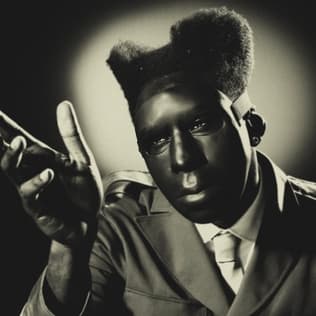
Poster / promotional material via Wikipedia, Chromakopia. Used under fair use for criticism and review.
CHROMAKOPIA, Tyler, the Creator’s eighth studio album, was released on Monday, October 28th, which was an unusual release-day choice (albums are almost universally released on Fridays) made deliberately by Tyler to signal that the record was operating outside of standard promotional-cycle expectations. The decision worked. The album debuted at number one on the Billboard 200, has held cultural presence across the subsequent weeks, and is, as of this writing in mid-November, the most-discussed hip-hop release of the second half of 2024.
The record is also, I think, Tyler’s most complicated album to date, and the complication is worth working through.
What the record is
Fourteen tracks, fifty-four minutes, produced primarily by Tyler himself with contributions from specific collaborators (Daniel Caesar, Childish Gambino, Doechii, LaToya Jackson, Santigold, Lil Wayne, Sexyy Red, Schoolboy Q, Teezo Touchdown, Lola Young, and others). The sonic palette is unmistakably Tyler: specific jazz-chord harmonies, specific synth-bass lines, specific vocal processing techniques that have become his production signature.
What is different this time is the emotional register. Tyler’s previous albums have, across the last decade, largely been character studies (the “Tyler Baudelaire” of Call Me If You Get Lost, the “Flower Boy” of Flower Boy, the “IGOR” of IGOR). Each record has given him a specific fictional alter ego through which to work specific emotional material.
CHROMAKOPIA largely dispenses with the character. The voice across the record is closer to Tyler himself, at 33, working through specifically adult concerns (his relationship with his mother, his ambivalence about fatherhood, his specific professional anxieties, his family-of-origin stories). The album feels, across its running time, less like a performance and more like a specific private conversation being made public.
Why the paranoia register works
The album’s dominant emotional tone is a specific kind of paranoia, and I mean this in a specific way. Tyler is not, across the record, performing fear of enemies or haters or other people (the standard commercial-rap paranoia register). He is performing fear of himself, of his own choices, of the specific shape his life has taken. The record is about the specific late-thirties anxiety of a person who has accumulated enough success to be, now, responsible for the specific self he has become.
This is a kind of paranoia that almost no commercial hip-hop record engages with. Tyler’s willingness to do so in the record’s central tracks (especially “Darling, I,” “Hey Jane,” “Tomorrow”) is the thing that separates this album from his previous work.
The mother tracks
The record’s specific emotional centre is the sequence of tracks that involve Tyler’s mother, Bonita Smith. Her voice is sampled across the record, delivering specific recorded messages to Tyler about his life, his choices, his future. These sequences are the record’s most direct emotional content.
“I Killed You,” the second track, samples his mother explicitly. “Hey Jane” is structured as a specifically imagined conversation about the possibility of his own future fatherhood. “Like Him,” the penultimate track, is a specific reflection on Tyler’s relationship with his father and the specific inheritance he has received from him.
None of these sequences are sentimental. Tyler writes about his family with a specific adult clarity that refuses the easier emotional shortcuts. The mother sequences are, specifically, full of complexity: his mother’s voice provides advice that he is not always willing to take; her commentary is loving and also critical; the record neither endorses nor rejects her position but presents it as one voice inside the larger conversation the album is having.
The production achievements
Several specific production moments on the record will, I think, be studied by other hip-hop producers. The way “Thought I Was Dead” uses a specific horn-section arrangement that layers against Schoolboy Q’s verse. The way “Sticky” builds its groove around a specific drum programming choice that rewards headphone listening. The way “Tomorrow” uses a specifically sparse arrangement to let the lyric carry the track.
Tyler has, across his career, been one of the most sonically ambitious hip-hop producers working, and CHROMAKOPIA is the record where his production instincts most fully serve his writing.
Where the album is weakest
One complaint. The album’s middle stretch, roughly tracks six through nine, features several guest verses (from Lil Wayne, Schoolboy Q, Sexyy Red, Doechii) that are technically competent but that sometimes feel additive rather than essential. The record would be sharper if two of these guest appearances were cut.
This is a common issue with hip-hop albums at this commercial tier: guest verses are a specific currency that drives streaming numbers, and omitting them costs commercial reach. Tyler’s decision to include them is understandable. The record would, nevertheless, be stronger without some of them.
What the album signals
CHROMAKOPIA has consolidated Tyler’s position as one of the three or four most important hip-hop artists of his generation (alongside Kendrick Lamar, Earl Sweatshirt, and Jack Harlow in a secondary tier). More specifically, the record has confirmed that Tyler’s career is not going to follow the conventional hip-hop commercial arc of declining relevance after a specific peak. He is, at 33, making his most critically-significant work.
The Monday release, which I noted at the top, is worth returning to. The decision to release on a non-Friday, outside standard industry-release conventions, is a signal about where Tyler now sits commercially. He is, at this point, outside the standard industry machinery. His records are events because they are his records, not because the industry has pushed them.
This is the career position that very few artists ever achieve. Tyler has achieved it. CHROMAKOPIA is the record that confirms it.
Put the album on in sequence, not shuffled. Pay attention to the mother sequences. Let the specific paranoia register be the argument. This is not a record for casual listening. This is a record for specifically paying attention.
Jules writes the kind of pieces that come from wandering somewhere and overhearing something. On Frame Junkie's masthead since the beginning.
MORE BY JULES OKONKWO →
Only God Was Above Us: Vampire Weekend at Full Power
Vampire Weekend's fifth album, released in April 2024 after a five-year wait, is the record where the band finally stopped being a band about youth. A year on, the shift is the interesting thing.
Kendrick vs Drake: Notes on a Massacre
A year after 'Not Like Us' broke streaming records, changed halftime shows, and drove a superstar into the career wilderness, the question is no longer who won. The question is what the beef actually was.
Chappell Roan: The Slow-Motion Pop Star
Chappell Roan's album came out in September 2023. Her stardom arrived in summer 2024. The eleven-month gap is the interesting thing.