Adolescence and the Cut That Never Comes
Each of the four episodes of Adolescence is a single unbroken take. The constraint is not a stunt. It is the show's whole argument, made in the grammar instead of the dialogue.
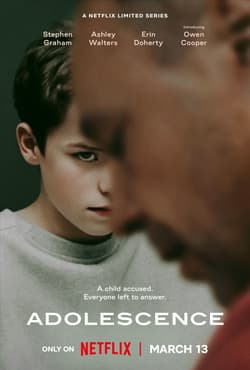
Promotional image via Wikipedia, Adolescence. Used under fair use for criticism and review.
The most formally radical piece of television of the past year is also one of the most watched, which almost never happens, and the two facts are connected. Adolescence, the four-part Netflix series written by Jack Thorne and Stephen Graham and directed by Philip Barantini, was shot so that each episode is a single continuous take, no cuts, no hidden joins, fifty-odd minutes of camera that never blinks. By the time it had finished sweeping the limited-series categories at the 2025 Emmys, with Graham, Erin Doherty, and the fifteen-year-old debutant Owen Cooper all taking acting prizes, the one-take had been written about everywhere as a feat. I want to put the feat to one side, because describing how hard something was to make tells you nothing about why it should have been made that way.
The why is the only question worth asking of a formal constraint this severe. A continuous take costs you everything an editor normally gives a drama: the reaction shot, the compression of dead time, the merciful cut away from a face that has nowhere left to go. You do not throw those tools away for a gimmick. You throw them away because the thing you are making cannot afford them.
What the form takes away
Consider what the cut usually does for us. In a conventional scene, when a moment becomes unbearable, the edit arrives like a held breath released. We cut to the listener. We cut to the clock. We cut to outside the window, and the time that passes in the gap is time we did not have to live through. The cut is the editor’s mercy, extended to the characters and, more quietly, to us.
Adolescence withholds that mercy on principle. Its subject is a thirteen-year-old boy and the killing he is accused of, and the show’s deepest conviction is that no one involved gets to look away, not the family, not the police, not the school, not the audience that arrived for a thriller. The unbroken take is how that conviction is built into the grammar. When the camera is in a room with these people, it stays in the room, in real time, with no escape hatch. The form is the argument. You are not permitted the relief of the cut because the people on screen are not permitted it either.
The third hour
Barantini and his cinematographer Matthew Lewis vary the device across the four episodes rather than simply repeating it, and the variation is where the series proves it understands its own method. The first episode rides the procedure of an arrest from a dawn raid through booking and processing, the camera bound to the bureaucracy, and the relentlessness of the take turns paperwork into dread. The second pulls a trick that has been justly admired, the camera leaving a school and lifting, impossibly, up and across the town to settle somewhere else entirely, a movement that should feel like showing off and instead feels like the world widening to take in how far the damage travels.
But the series lives or dies on its third episode, and it lives. This is the chamber piece, a near-real-time two-hander between Cooper’s Jamie and Doherty’s Briony, a clinical psychologist assessing him in a bare room. There is no town to fly over here, no procedure to ride, nothing but two people at a table and a camera that cannot cut. It is, in the most precise sense, theatre. I came to criticism from the theatre, and I recognise what this episode is doing: it is staging the unbearable thing that live performance does and screen drama usually refuses, which is to make the actor sustain a state of being with no net beneath them.
Watch what Cooper does with it. There is a moment, perhaps two-thirds through, when the boy’s manner turns, when the frightened child becomes something colder and then snaps back, and because the take does not cut, you watch the change happen on his face in continuous time rather than being handed it across an edit. A cut would have let the actor reset between the two registers. The unbroken take makes him carry the hinge himself, in front of you, and a fifteen-year-old carries it. Doherty’s work is the harder, quieter half: she has to keep Briony’s face doing professional composure while something underneath it gives way, and she has to do it for the length of a stage act, knowing the camera will catch any second she drops it.
What the constraint cannot do, and does anyway
The honest caution about a device this total is that it can flatten a show into one note, that real-time relentlessness becomes its own kind of monotony. Adolescence mostly escapes this because Thorne’s scripts keep changing what the take is for, dread in the first hour, grief in the last. The fourth episode, which follows the family some time after, uses the unbroken take not for tension but for endurance, the way a long Sunday with nowhere to put your hands is endurance. The form that trapped us in a police station now traps us in a kitchen with people trying and failing to behave normally, and it is somehow worse.
There is a temptation, given the show’s afterlife, to read it as an issue drama, the series about boys and phones and the violence that grows in the dark of a teenager’s bedroom. It became that in the culture, screened in schools and discussed in Parliament. But the series is not finally about its topic. It is about complicity, about the impossibility of standing outside a thing once you have been made to watch it whole. The one-take is not the show’s gimmick and it is not even the show’s style. It is the show’s ethics, the decision that there will be no edit to hide behind, made fifty minutes at a time, four times over.
Priya came to criticism sideways from theatre. She is patient with slow shows, short with bloated ones, and cheerfully vicious about lazy writing.
MORE BY PRIYA NAIR →
A Thousand Blows Finds Steven Knight a Frame Large Enough for His Obsessions
Steven Knight's Victorian boxing drama dropped on Disney+ and Hulu in February 2025. Six episodes in, the show's interest in three parallel hustles is what makes the frame hold.

Dying for Sex: Michelle Williams, Jenny Slate, and the Limited Series as Vessel
Liz Meriwether's eight-episode FX series handed Michelle Williams the role of the decade and Jenny Slate the best supporting performance on television last year.
Say Nothing and the Problem of Adapting a Book That Cannot Be Filmed
Joshua Zetumer's FX adaptation of Patrick Radden Keefe's Troubles-era book is a better television show than many people expected. It is also a book that perhaps should not have been adapted at all.