A Thousand Blows Finds Steven Knight a Frame Large Enough for His Obsessions
Steven Knight's Victorian boxing drama dropped on Disney+ and Hulu in February 2025. Six episodes in, the show's interest in three parallel hustles is what makes the frame hold.

Poster / promotional material via Wikipedia, A Thousand Blows. Used under fair use for criticism and review.
Steven Knight’s A Thousand Blows arrived on Disney+ in the UK and Europe and on Hulu in the US on 21 February 2025. The first season runs six episodes. Disney has commissioned a second season that will run six more, with filming reported to have completed before the first season aired. The show is a period drama set in 1880s London, organised around the East End’s bare-knuckle boxing culture and a parallel women’s-led criminal syndicate called the Forty Elephants. The frame is larger than many of Knight’s previous projects, and the craft question is whether he can run the frame at this scale without the looseness that has worked against some of his earlier television work.
I want to argue he can, and that the reasons why have to do with how the show’s three parallel plot lines balance each other, how the ensemble absorbs weight the lead roles would otherwise carry alone, and how the period detail is treated as a working environment rather than as decoration.
What the show is running
The central narrative is Hezekiah Moscow (Malachi Kirby), a Jamaican immigrant who has arrived in London with his friend Alec Munroe (Francis Lovehall) in the hope of finding work and has instead found the bare-knuckle circuit as the means of survival available to him. Moscow is a real historical figure. So is Sugar Goodson (Stephen Graham), the established East End fighter whose turf Hezekiah has unknowingly entered and whose relationship to the circuit is the antagonist-engine of the first season.
Running in parallel is the Forty Elephants, the real-world all-female London gang active in the late nineteenth century. Erin Doherty plays Mary Carr, the gang’s queen. The show uses the Forty Elephants storyline as a thematic counterpoint to the boxing material: two kinds of survival work, both extra-legal, both shaped by the class and gender constraints of their moment.
The third storyline, which the first season develops slowly, concerns Hezekiah’s entry into the orbit of a wealthy patron and the class transaction that patronage involves. This strand is the one that tests Knight’s balancing work, because it risks pulling the register toward costume-drama Victoriana. Knight keeps the register honest by shooting the patronage material with the same interest in economic logic that the boxing and gang material receive.
The boxing, and how the show films it
Boxing on screen has a specific craft history. Raging Bull, The Fighter, Warrior, and Million Dollar Baby each solved a version of the problem of making a fight legible and meaningful. Television has had fewer successes in this register. A Thousand Blows is inventing a specific solution for bare-knuckle period boxing across its first season.
The fights are staged with attention to the physics of bare-knuckle work as distinct from gloved fighting. Hands are treated as breakable. Faces are treated as vulnerable real estate. The pacing of fight sequences is built around the rhythm of an 1880s bout, which is slower and more exhausted than modern boxing. Camera work is close but not hyperactive, and editorial cuts give the audience room to read exchanges rather than blurring them into impressionism.
What this produces on screen is a sense that the fighters are at risk, tired, and diminished by the work in ways modern boxing films rarely achieve. Kirby, who trained for the role, carries the physical performance without it looking like boxing-film choreography. Graham, whose Sugar is a fighter in decline, plays the decline in his body across every scene, and the physical detail of his work is what gives the antagonist weight.
Kirby, Doherty, Graham
Malachi Kirby has been doing excellent television work for about a decade (Roots, Small Axe’s “Mangrove” episode, The Last Kingdom), and A Thousand Blows gives him the scale of role his work has been heading toward. Hezekiah is written as a man of quiet intelligence and quiet pride. Kirby plays both registers without forcing either. The emotional temperature stays legible across six episodes without the show having to make Hezekiah narrate his interior. Kirby does the work on his face.
Erin Doherty, whose Princess Anne on The Crown demonstrated what she could do with a specifically constrained emotional register, plays Mary Carr with a broader range. Carr is running a gang, running a romantic life, running an interior ethical calculation, and Doherty gives each register its own texture. The gang scenes have a different tonal weight than the romantic scenes, and the difference is Doherty calibrating.
Stephen Graham’s Sugar is the heart of the show’s antagonist structure. Graham’s strength across his career has been in playing men whose violence is a consequence of a particular exhaustion, and Sugar is that kind of man. The show could have written him as a cartoon villain. Knight does not, and Graham does not. Sugar has legible reasons for every choice he makes inside the first season, and the reasons are the show’s subject.
The period, as a working environment
Knight’s Peaky Blinders earned a reputation for atmospheric period drama, and A Thousand Blows works at a similar scale of set, costume, and production design without the pop-anachronism register Peaky Blinders sometimes leaned on. The music cues here are period-appropriate rather than anachronistic. The visual grade sits in a warm underlit register that reads as nineteenth-century gas-light rather than as pastiche. The decision to avoid the Peaky anachronism is, in my view, the right one for this material.
The show’s London is a working environment. Characters work. The work is paid, exhausting, and shaped by the economic constraints of 1880s London. Hezekiah works. Mary Carr works. Sugar works. The boxing, the gang work, and the patron relationship are all framed as economic arrangements between specific people. The show is not romanticising any of them. The register of economic interest is the spine the show hangs its three parallel plots on.
What the show is not doing
A Thousand Blows is not trying to be Peaky Blinders with boxing. It works at roughly the same production scale in a different register. The ensemble here is more balanced than Peaky’s Tommy-centric structure. The historical register is closer to the ground than Peaky’s more operatic mode. The emotional register is less interested in the Byronic-gangster heat Peaky ran across six seasons and more interested in the quieter question of how people at the bottom of the class structure survive.
The show is also not running a conventional sports-drama rise arc. Hezekiah’s progression across the first season is not the standard underdog-prizefighter shape. The shape is messier. The gains are partial. The setbacks are not always narratively motivated. This is, inside the genre, brave. A more conventional adaptation would have run the rise arc in a cleaner shape. Knight and the room have refused the cleaner shape, and the refusal is what gives the first season its weight.
What the six episodes build toward
The final episode closes the first major plot arc without resolving the larger show. Several secondary storylines are left open, and the decision to defer them to the second season is a structural choice rather than a lazy cliffhanger. The second season is already filmed. The pacing across the two seasons has been planned as a single twelve-episode arc rather than as two standalone runs. The first six episodes read better if the audience understands they are the first half of a longer shape.
What stays
The thing A Thousand Blows gets right that a lot of prestige period drama does not is the interest in work as the thing the characters are actually doing. Most prestige period drama treats work as the backdrop for romantic or political plotting. A Thousand Blows treats work as the subject. The boxing is work. The gang work is work. The patron relationship is work. The show’s honesty about the economic register is what gives the six episodes their weight.
The second season arrives whenever Disney chooses to put it out. If it extends the pacing, the balance across the three plot lines, and the interest in work that the first season established, A Thousand Blows will be one of the shows that defines its year.
Priya came to criticism sideways from theatre. She is patient with slow shows, short with bloated ones, and cheerfully vicious about lazy writing.
MORE BY PRIYA NAIR →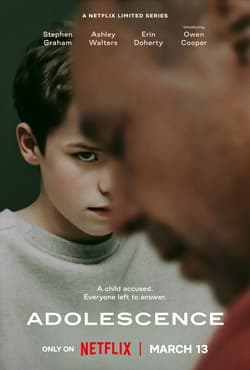
Adolescence and the Cut That Never Comes
Each of the four episodes of Adolescence is a single unbroken take. The constraint is not a stunt. It is the show's whole argument, made in the grammar instead of the dialogue.

Dying for Sex: Michelle Williams, Jenny Slate, and the Limited Series as Vessel
Liz Meriwether's eight-episode FX series handed Michelle Williams the role of the decade and Jenny Slate the best supporting performance on television last year.

Paradise: The Bunker Twist That Reframes the Show
Dan Fogelman's Paradise uses a first-episode reveal as a structural argument. The reveal works; what the show does with it is the interesting part.